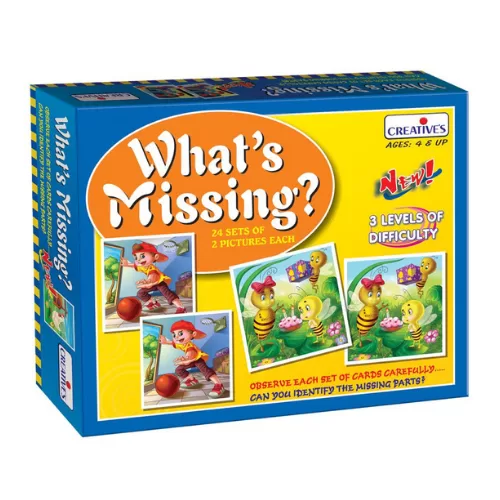
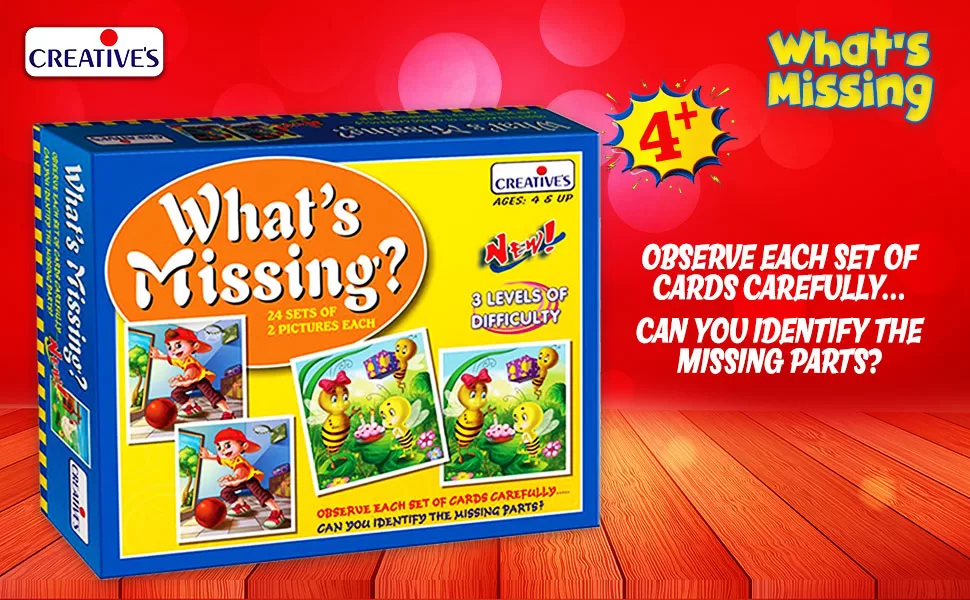
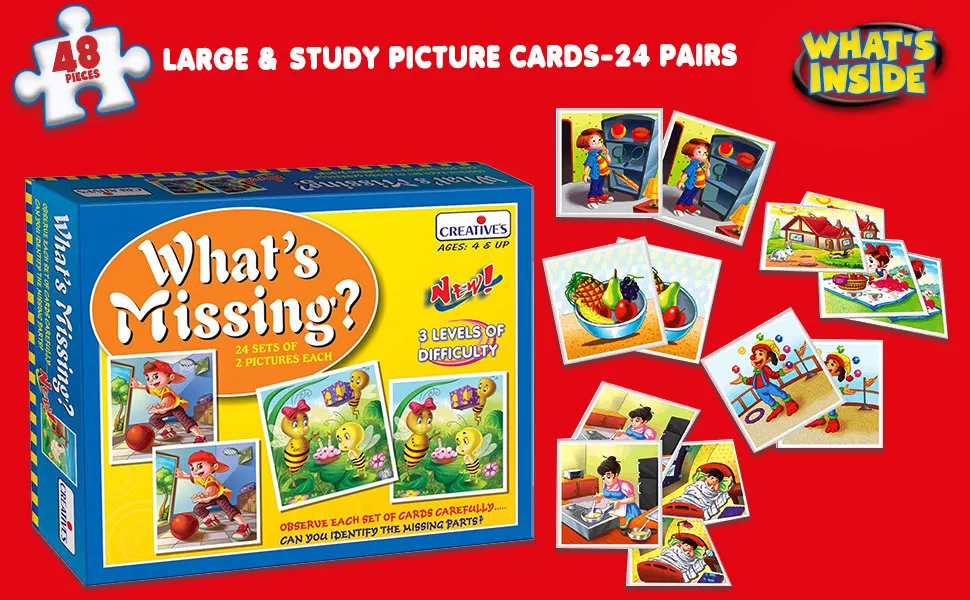
Creative’s What’s Missing? is a find-the-missing-parts card game with 48 large sturdy cards across four difficulty levels that sharpens observation, visual discrimination, verbal expression, and problem solving in children from age 4. Used at home, in early years classrooms, and in structured play and therapy-friendly learning settings.
About This Product
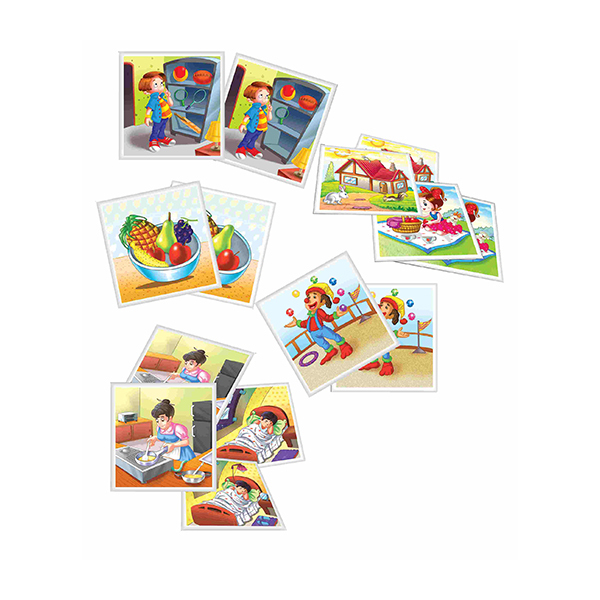
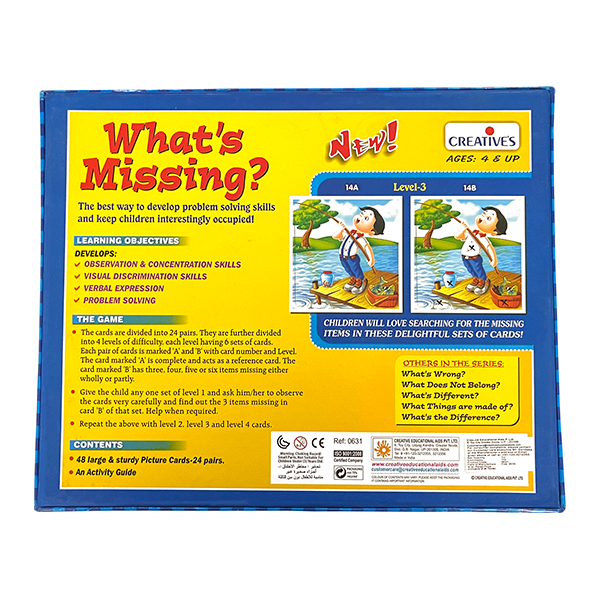
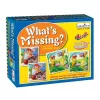
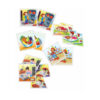
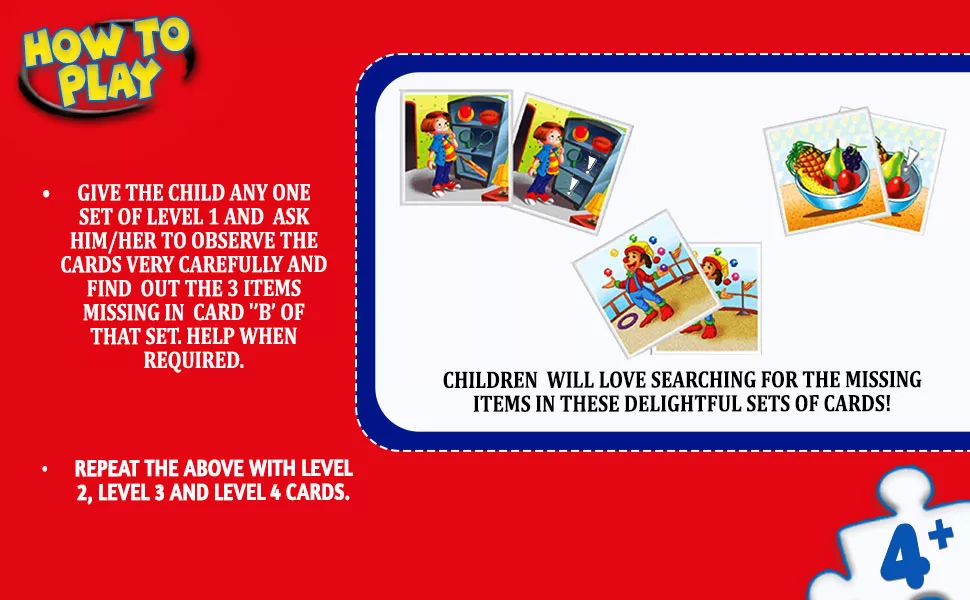
WHAT’S MISSING OBSERVATION CARD GAME AGES 4 — 48 large sturdy cards in 24 pairs challenge children to study a complete scene and find 3 to 6 items that have been removed or altered in the matching card.
4 DIFFICULTY LEVELS VISUAL DISCRIMINATION CARD GAME — Six card pairs per level take children from straightforward missing objects all the way to partially altered or subtly removed details — a structured challenge that grows with the child.
SCREEN-FREE VERBAL EXPRESSION PROBLEM SOLVING ACTIVITY — No batteries or apps — children observe, identify, and explain what is missing, building focused attention and precise spoken language in every session.
EARLY YEARS CONCENTRATION SKILLS HOME & CLASSROOM GAME —
Often used in structured play and therapy-friendly learning settings; supports hands-on learning across home, classroom and therapy environments.
QUALITY, SAFETY & TRUST — Creative’s products are proudly made in India, conforming to BIS Safety Standards (IS 9873 – Part 1) and EN71 Part 1, 2 & 3 with European Toy Safety Standards trusted by parents and educators since 1987.
Creative’s What’s Missing? is a find-the-missing-parts picture card
game with 48 large sturdy cards in 24 pairs, organised across four
levels of increasing difficulty. Each pair gives children a complete
reference card (A) and a changed card (B) where three to six items
have been removed or altered. For children aged 4 and up, it delivers
a focused visual and language challenge in every session.
Children study Card A, then compare it carefully with Card B to find
what is gone. At early levels the missing items are obvious; at later
levels they become partial or subtle, requiring genuine concentration.
Finding each item and saying what it is builds vocabulary and verbal
reasoning alongside the visual work.
Parents value this set because four levels mean it stays genuinely
challenging as the child grows. Teachers choose it because systematic
visual scanning and the ability to describe what is missing are skills that
feed directly into early reading, science, and classroom observation.
HOW CHILDREN LEARN
A child studies the complete Card A scene carefully, then looks at
Card B and must notice what has been removed or changed that
sustained visual comparison directly trains attention and working memory.
Finding a missing item is only half the task: explaining it out loud
“the bucket is gone” or “the bee’s wing is missing” actively develops
precise vocabulary and verbal expression.
The four-level structure means children always work at the right level
of challenge: early levels build confidence, later levels demand real
concentration and fine visual discrimination.
When a child misses an item and an adult points it out, they go back
and look again — that self-correction loop builds perseverance and
the habit of looking carefully before concluding.
Repeated play across all 24 scene pairs strengthens the habit of
systematic visual scanning — a skill that transfers directly into
reading readiness and classroom observation tasks.
SKILLS DEVELOPED
Observation & Concentration
Visual Discrimination
Verbal Expression & Language Development
Problem Solving
Focus and Attention
Cognitive Development & Visual Memory
Hand-Eye Coordination
WHO IS IT FOR
Children aged 4 to 8 who are ready to study detailed pictures
carefully and explain what they see and what is missing.
Parents looking for a screen-free activity that holds a young child’s
attention through genuine visual challenge rather than novelty.
Early years and primary teachers who need a ready-made observation
and language activity for individual or small-group sessions.
Homeschooling parents covering visual thinking, language development,
and early concentration skills through structured card play.
Speech and language support educators who use picture description and
verbal expression tasks in therapy-friendly learning settings.
Gift-givers looking for a bright, durable educational game that a
4-year-old can grow with through four levels of challenge.
PRODUCT FEATURES TABLE
Age Group: 4 Years and Up
Players: 1 or more (individual, paired, or group)
Play Type: Find-the-Missing-Parts Observation Card Activity
Creative’s What’s Missing? is a find-the-missing-parts picture card
game with 48 large sturdy cards in 24 pairs, organised across four
levels of increasing difficulty. Each pair gives children a complete
reference card (A) and a changed card (B) where three to six items
have been removed or altered. For children aged 4 and up, it delivers
a focused visual and language challenge in every session.
Children study Card A, then compare it carefully with Card B to find
what is gone. At early levels the missing items are obvious; at later
levels they become partial or subtle, requiring genuine concentration.
Finding each item and saying what it is builds vocabulary and verbal
reasoning alongside the visual work.
Parents value this set because four levels mean it stays genuinely
challenging as the child grows. Teachers choose it because systematic
visual scanning and the ability to describe what is missing are skills that
feed directly into early reading, science, and classroom observation.
HOW CHILDREN LEARN
A child studies the complete Card A scene carefully, then looks at
Card B and must notice what has been removed or changed that
sustained visual comparison directly trains attention and working memory.
Finding a missing item is only half the task: explaining it out loud
“the bucket is gone” or “the bee’s wing is missing” actively develops
precise vocabulary and verbal expression.
The four-level structure means children always work at the right level
of challenge: early levels build confidence, later levels demand real
concentration and fine visual discrimination.
When a child misses an item and an adult points it out, they go back
and look again — that self-correction loop builds perseverance and
the habit of looking carefully before concluding.
Repeated play across all 24 scene pairs strengthens the habit of
systematic visual scanning — a skill that transfers directly into
reading readiness and classroom observation tasks.
SKILLS DEVELOPED
Observation & Concentration
Visual Discrimination
Verbal Expression & Language Development
Problem Solving
Focus and Attention
Cognitive Development & Visual Memory
Hand-Eye Coordination
WHO IS IT FOR
Children aged 4 to 8 who are ready to study detailed pictures
carefully and explain what they see and what is missing.
Parents looking for a screen-free activity that holds a young child’s
attention through genuine visual challenge rather than novelty.
Early years and primary teachers who need a ready-made observation
and language activity for individual or small-group sessions.
Homeschooling parents covering visual thinking, language development,
and early concentration skills through structured card play.
Speech and language support educators who use picture description and
verbal expression tasks in therapy-friendly learning settings.
Gift-givers looking for a bright, durable educational game that a
4-year-old can grow with through four levels of challenge.
PRODUCT FEATURES TABLE
Age Group: 4 Years and Up
Players: 1 or more (individual, paired, or group)
Play Type: Find-the-Missing-Parts Observation Card Activity