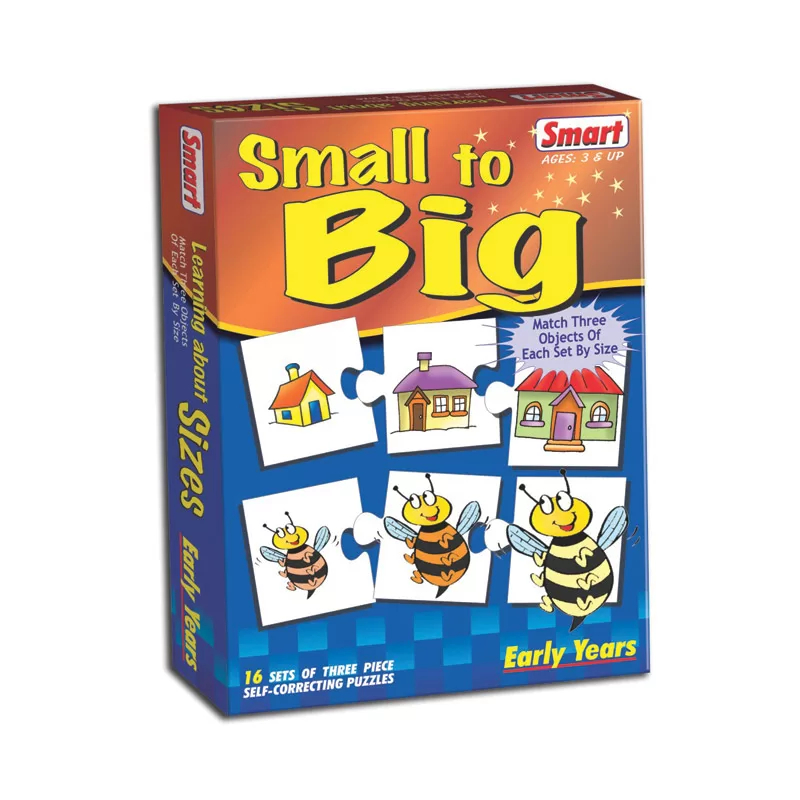
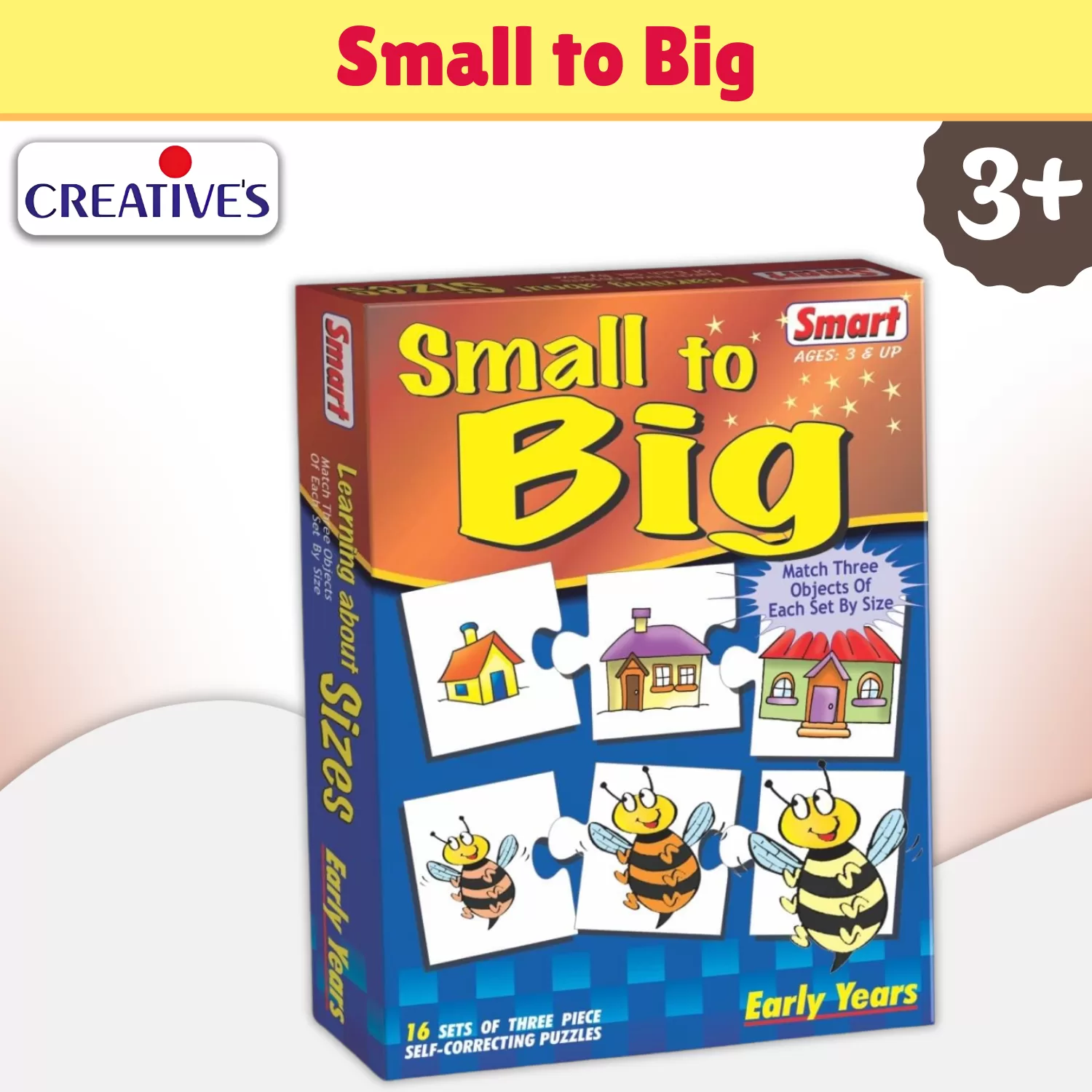
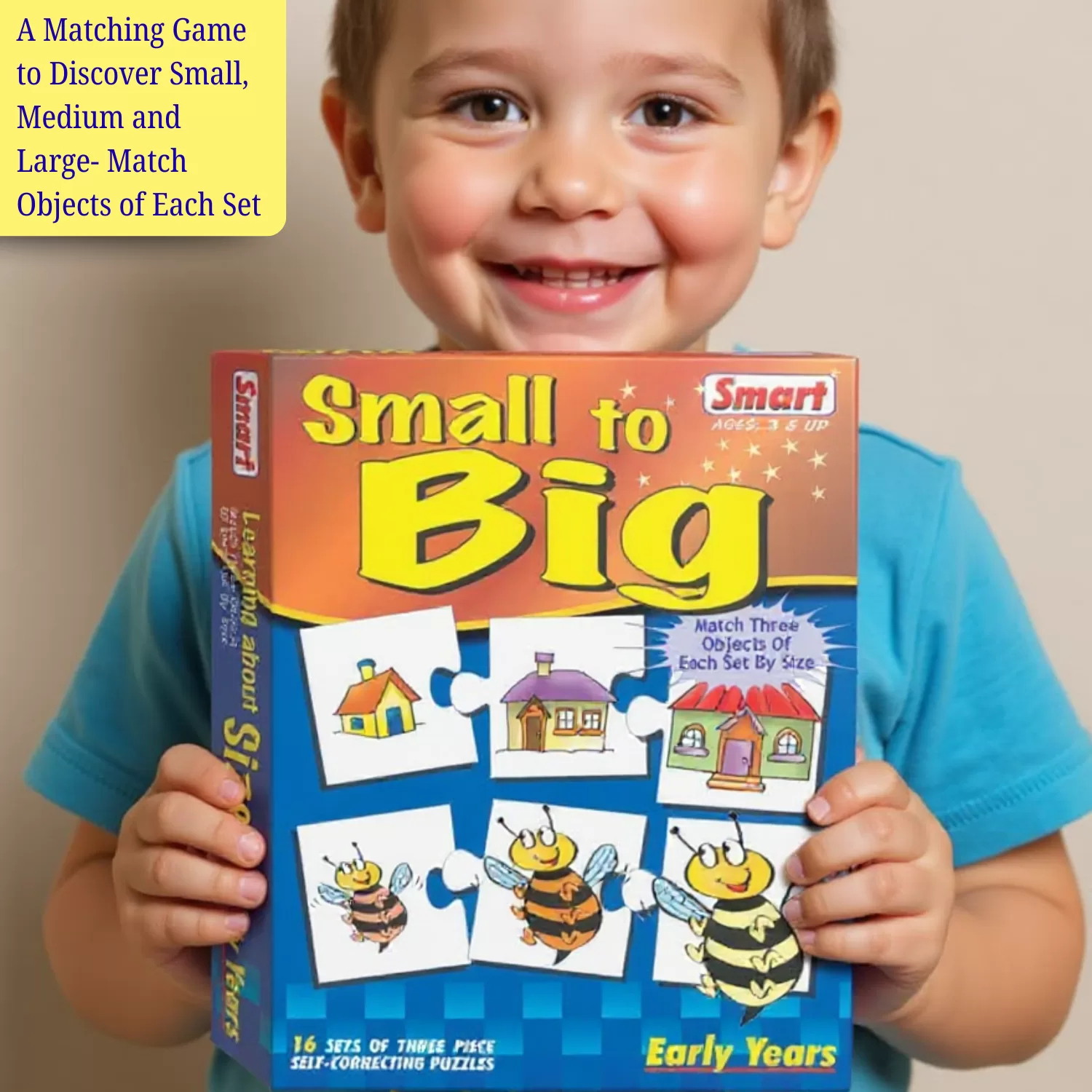
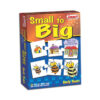
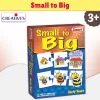
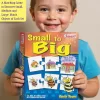
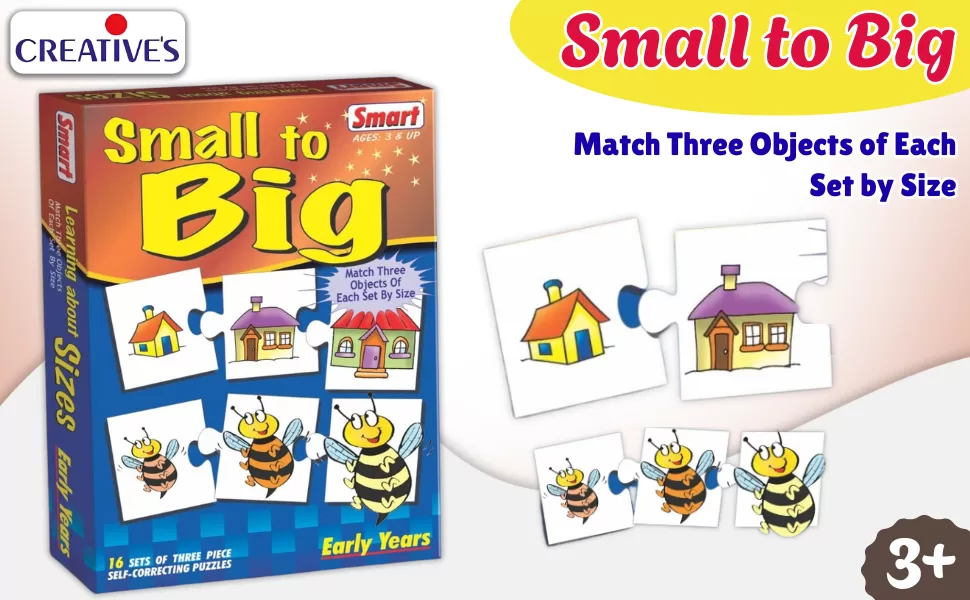
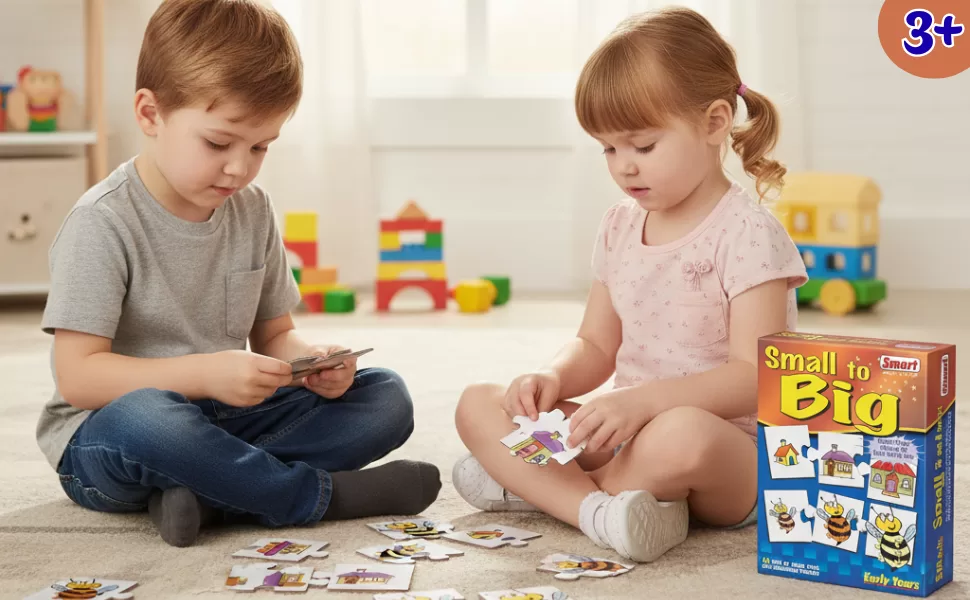
Smart Small to Big gives children aged 3 and up 16 sets of three-piece self-correcting puzzles each ordering the same object in small, medium, and large. Houses, bees, and more must be arranged from smallest to biggest. Builds size comparison, sequencing, and the early maths language of big, medium, and small.
About This Product
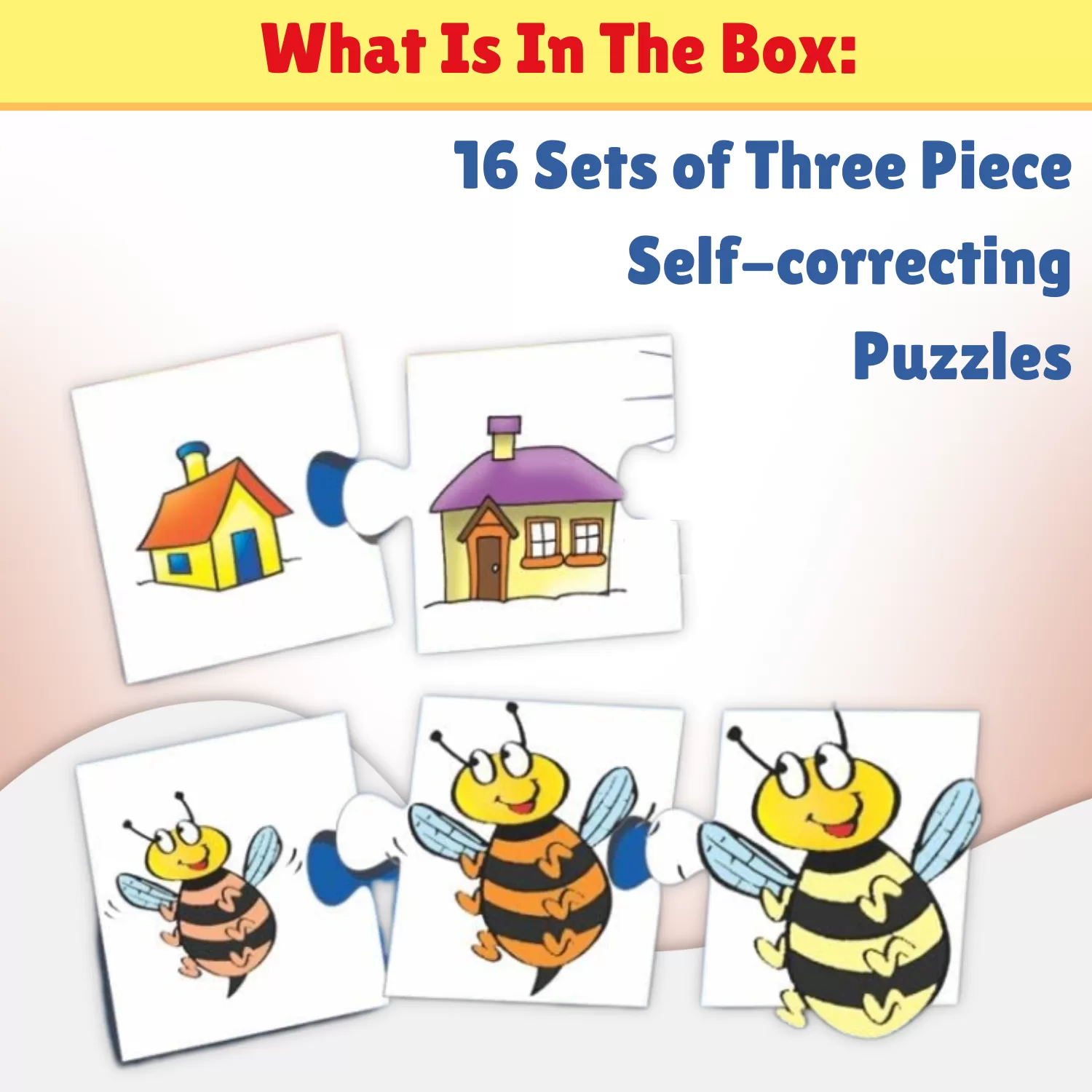
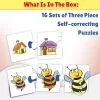
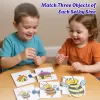
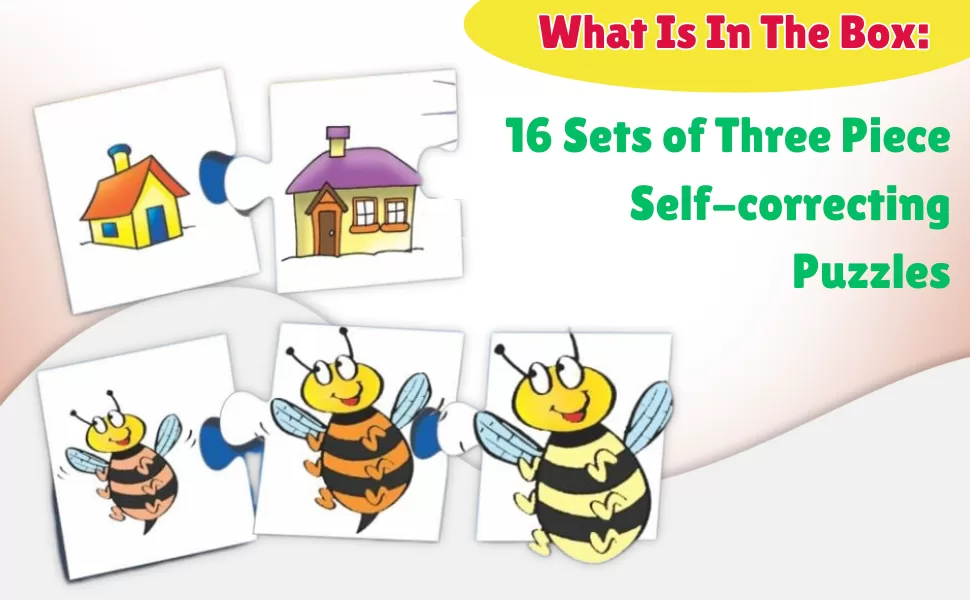
SIZE SEQUENCING PUZZLE SMALL MEDIUM LARGE AGES 3 – 16 sets of three-piece self-correcting puzzles – each set orders the same object from small to medium to large; houses, bees, and more.
THREE-PIECE PUZZLE FORMAT UNIQUE IN THE SERIES – Unlike standard two-piece matching puzzles, each set has three pieces that must be arranged in the correct size order – introducing sequencing alongside size comparison.
SELF-CORRECTING PUZZLE SHAPES INDEPENDENT PLAY – Each three-piece set has unique interlocking shapes – only the correct small-medium-large arrangement physically fits together, giving children independent self-checking feedback.
SIZE COMPARISON EARLY MATHS LANGUAGE HOME & CLASSROOM – Builds the foundational maths vocabulary of big, bigger, biggest and small, smaller, smallest – the size comparison language that early maths instruction depends on.
QUALITY, SAFETY & TRUST – Smart Early Years products are proudly made in India, conforming to CE Mark safety standards – trusted by parents and educators as part of the Early Years Series.
Smart Small to Big takes the self-correcting puzzle format of the Smart
Early Years series and raises the cognitive challenge: each of the 16 sets
has three pieces rather than two, and they must be placed in the correct
size order from small to medium to large. Houses, bees, and more appear
in three sizes in each set - and only the correct arrangement allows all
three pieces to interlock. No adult is needed to verify the sequence.
The three-piece format introduces a concept that two-piece matching
cannot: ordering. A child sorting two pieces either has it right or wrong.
A child ordering three pieces must think about both pieces relative to
each other and to the middle piece - a genuine cognitive step up that
builds sequential thinking and comparative reasoning simultaneously.
The 16 sets give enough variety to build a generalised understanding of
size as a relative, not absolute, concept.
Parents and teachers choose Small to Big because the size comparison
vocabulary it builds - big, bigger, biggest; small, smaller, smallest - is
directly used in early maths instruction. It is often used in structured
play and therapy-friendly learning settings for size discrimination,
ordering, and early mathematical language development.
It completes the Smart Early Years self-correcting puzzle series as
the sequencing set.
How Children Learn
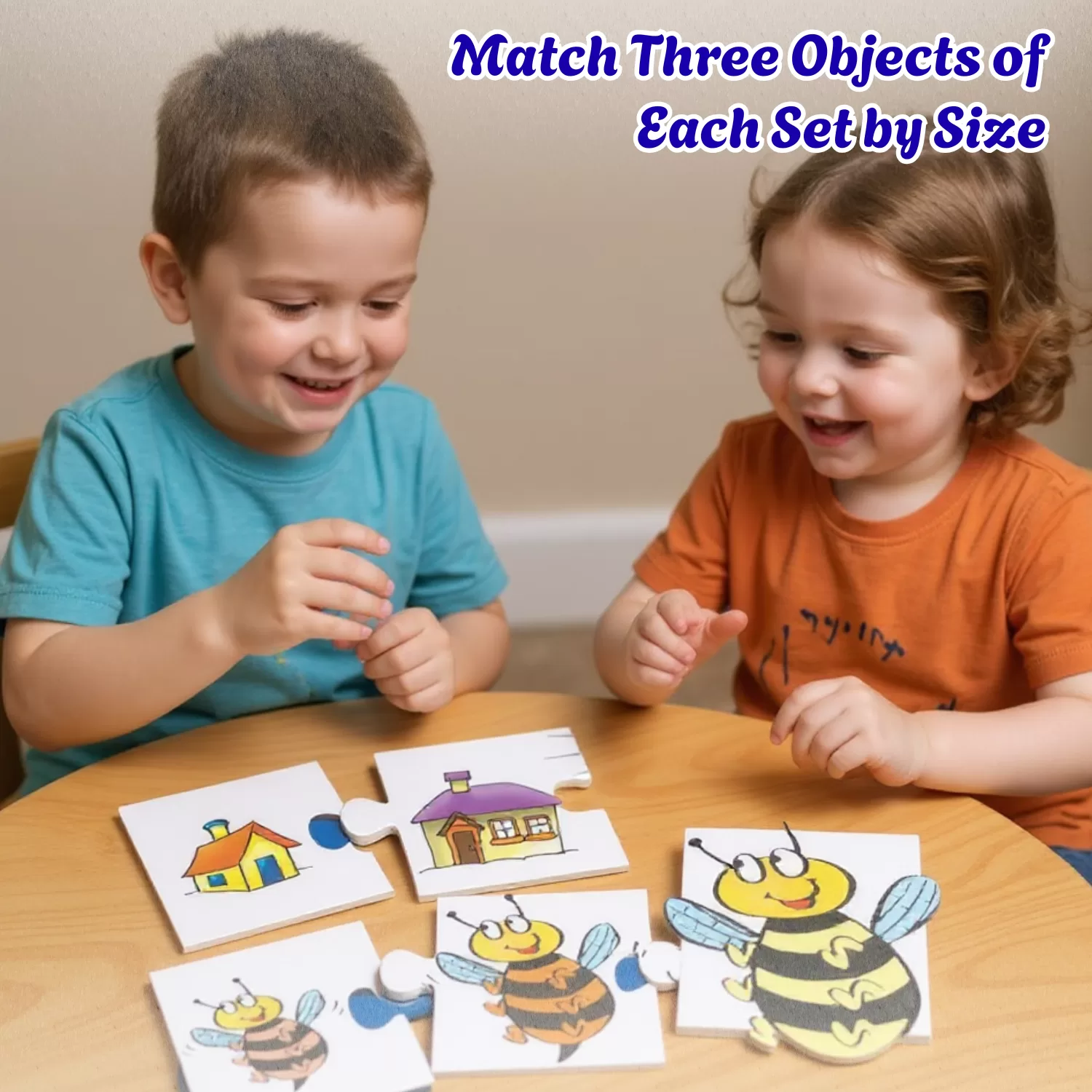
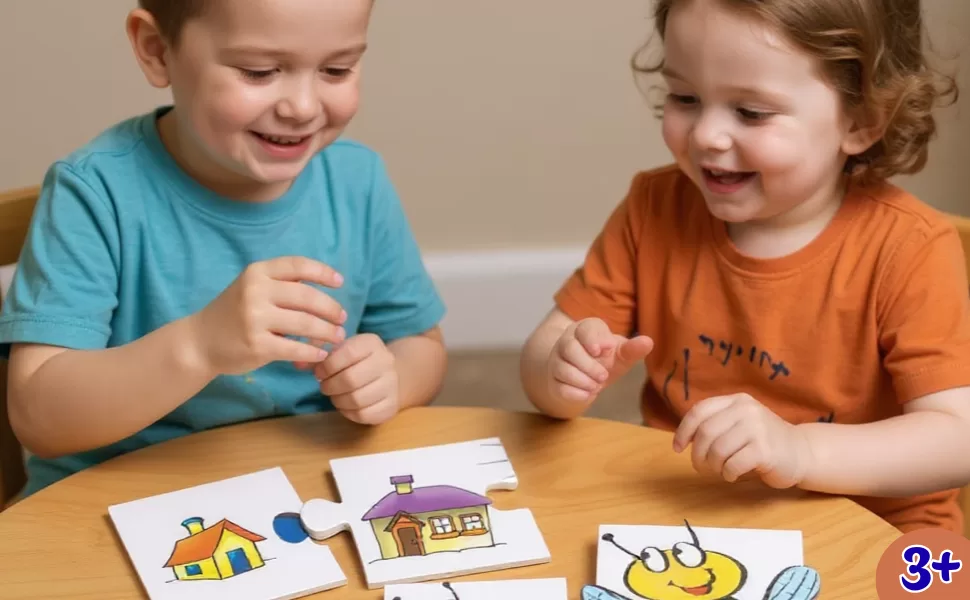
A child tips out a set of three house pieces - small, medium, and
large - and must arrange them in order from left to right.
This is not just sorting: it requires comparing all three sizes
simultaneously and placing each in relation to the others, not just
identifying 'the big one'.
The self-correcting three-piece puzzle confirms the arrangement:
only the correct small-medium-large order allows all three pieces
to interlock. A child who places medium first and small last will find
the pieces won't fit together - the puzzle mechanism corrects sequencing
errors without adult involvement.
Working through 16 different object sets means children practice
small-medium-large ordering across a variety of subjects - houses,
bees, and more - building a generalised understanding of size as a
relative concept rather than an absolute one tied to a specific object.
Talking through each set - 'this bee is small, this one is medium, this
is the biggest' - builds the comparative language that early maths
instruction (bigger than, smaller than, equal to) depends on.
The puzzle activity gives parents and teachers a natural prompt
for this language.
This is the only three-piece puzzle in the Smart Early Years series,
making it a natural progression after children have mastered the
two-piece matching sets. The additional piece introduces the concept
of ordering rather than just matching - a step from binary thinking
to sequential thinking.
Skills Developed
Size Comparison & Ordering
Sequential Thinking
Early Maths Language (big/bigger/biggest)
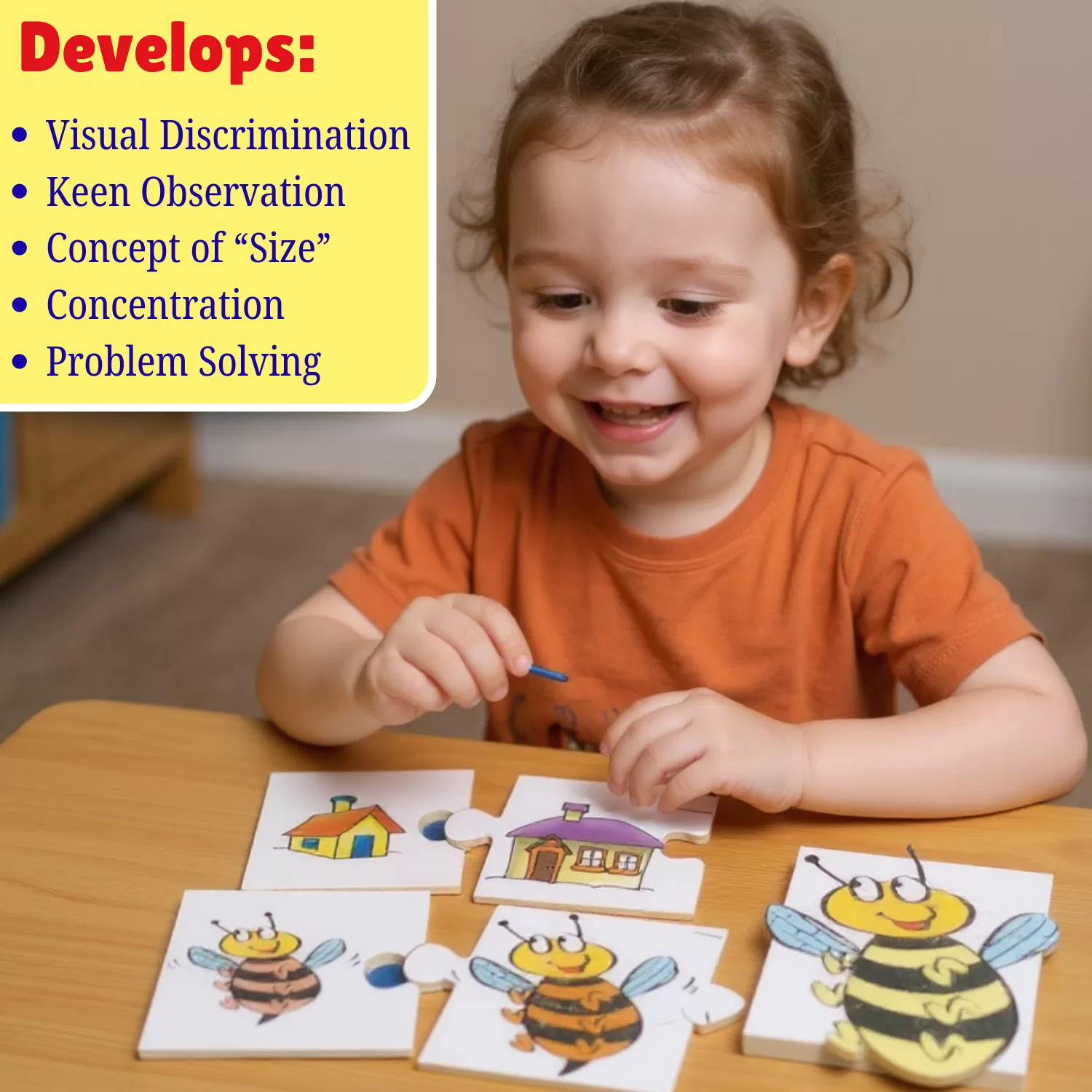
Visual Discrimination
Cognitive Development
Concentration & Focus
Problem Solving
Who Is It For
Children aged 3 and above who can match objects and are ready
to sequence them by size in small, medium, and large order.
Parents looking for a self-correcting puzzle that introduces
ordering and sequencing rather than simple matching.
Nursery and reception teachers covering size comparison and
ordering as part of early maths.
Parents who own other Smart Early Years self-correcting sets
and want the next progression for their child.
Occupational therapists and early years practitioners using size
ordering activities for visual discrimination and spatial reasoning.
Gift-buyers looking for a maths-readiness puzzle that introduces
ordering concepts for a child aged 3 to 6.
PRODUCT FEATURES
Age Group: 3 Years & Above Number of Players: 1 or more Play Type: Self-Correcting Size Sequencing Puzzle • Early Maths Activity Educational Category: Size Comparison • Ordering
• Early Maths Language • Sequential Thinking Contents: 16 Sets of Three-Piece Self-Correcting Puzzles (48 pieces total) Puzzle Format: Three-piece sets small, medium, and large pieces per set Objects Confirmed: Houses (small/medium/large)
• Bees (small/medium/large) Self-Correcting Feature: Each three-piece set has unique
interlocking shapes only the correct small medium–large order fits Series Context: Sequencing set within the Smart Early Years
self-correcting puzzle series — natural progression after two-piece sets Brand: Smart Early Years Series Safety Certifications:(please confirm from physical box) CE • IS 9873 • BIS Reference Number: 01012
Smart Small to Big takes the self-correcting puzzle format of the Smart
Early Years series and raises the cognitive challenge: each of the 16 sets
has three pieces rather than two, and they must be placed in the correct
size order from small to medium to large. Houses, bees, and more appear
in three sizes in each set – and only the correct arrangement allows all
three pieces to interlock. No adult is needed to verify the sequence.
The three-piece format introduces a concept that two-piece matching
cannot: ordering. A child sorting two pieces either has it right or wrong.
A child ordering three pieces must think about both pieces relative to
each other and to the middle piece – a genuine cognitive step up that
builds sequential thinking and comparative reasoning simultaneously.
The 16 sets give enough variety to build a generalised understanding of
size as a relative, not absolute, concept.
Parents and teachers choose Small to Big because the size comparison
vocabulary it builds – big, bigger, biggest; small, smaller, smallest – is
directly used in early maths instruction. It is often used in structured
play and therapy-friendly learning settings for size discrimination,
ordering, and early mathematical language development.
It completes the Smart Early Years self-correcting puzzle series as
the sequencing set.
How Children Learn
A child tips out a set of three house pieces – small, medium, and
large – and must arrange them in order from left to right.
This is not just sorting: it requires comparing all three sizes
simultaneously and placing each in relation to the others, not just
identifying ‘the big one’.
The self-correcting three-piece puzzle confirms the arrangement:
only the correct small-medium-large order allows all three pieces
to interlock. A child who places medium first and small last will find
the pieces won’t fit together – the puzzle mechanism corrects sequencing
errors without adult involvement.
Working through 16 different object sets means children practice
small-medium-large ordering across a variety of subjects – houses,
bees, and more – building a generalised understanding of size as a
relative concept rather than an absolute one tied to a specific object.
Talking through each set – ‘this bee is small, this one is medium, this
is the biggest’ – builds the comparative language that early maths
instruction (bigger than, smaller than, equal to) depends on.
The puzzle activity gives parents and teachers a natural prompt
for this language.
This is the only three-piece puzzle in the Smart Early Years series,
making it a natural progression after children have mastered the
two-piece matching sets. The additional piece introduces the concept
of ordering rather than just matching – a step from binary thinking
to sequential thinking.
Skills Developed
Size Comparison & Ordering
Sequential Thinking
Early Maths Language (big/bigger/biggest)
Visual Discrimination
Cognitive Development
Concentration & Focus
Problem Solving
Who Is It For
Children aged 3 and above who can match objects and are ready
to sequence them by size in small, medium, and large order.
Parents looking for a self-correcting puzzle that introduces
ordering and sequencing rather than simple matching.
Nursery and reception teachers covering size comparison and
ordering as part of early maths.
Parents who own other Smart Early Years self-correcting sets
and want the next progression for their child.
Occupational therapists and early years practitioners using size
ordering activities for visual discrimination and spatial reasoning.
Gift-buyers looking for a maths-readiness puzzle that introduces
ordering concepts for a child aged 3 to 6.
PRODUCT FEATURES
Age Group: 3 Years & Above Number of Players: 1 or more Play Type: Self-Correcting Size Sequencing Puzzle • Early Maths Activity Educational Category: Size Comparison • Ordering
• Early Maths Language • Sequential Thinking Contents: 16 Sets of Three-Piece Self-Correcting Puzzles (48 pieces total) Puzzle Format: Three-piece sets small, medium, and large pieces per set Objects Confirmed: Houses (small/medium/large)
• Bees (small/medium/large) Self-Correcting Feature: Each three-piece set has unique
interlocking shapes only the correct small medium–large order fits Series Context: Sequencing set within the Smart Early Years
self-correcting puzzle series — natural progression after two-piece sets Brand: Smart Early Years Series Safety Certifications:(please confirm from physical box) CE • IS 9873 • BIS Reference Number: 01012
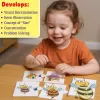
Works perfectly for our daily play time. Encourages independent play; my child tries again without getting upset. A nice learning toy that makes practice feel like play, not homework.








Works perfectly for our daily play time. Encourages independent play; my child tries again without getting upset. A nice learning toy that makes practice feel like play, not homework.