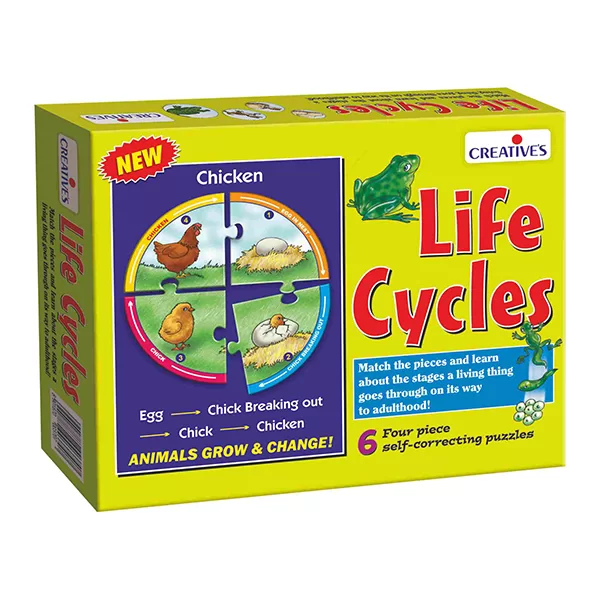
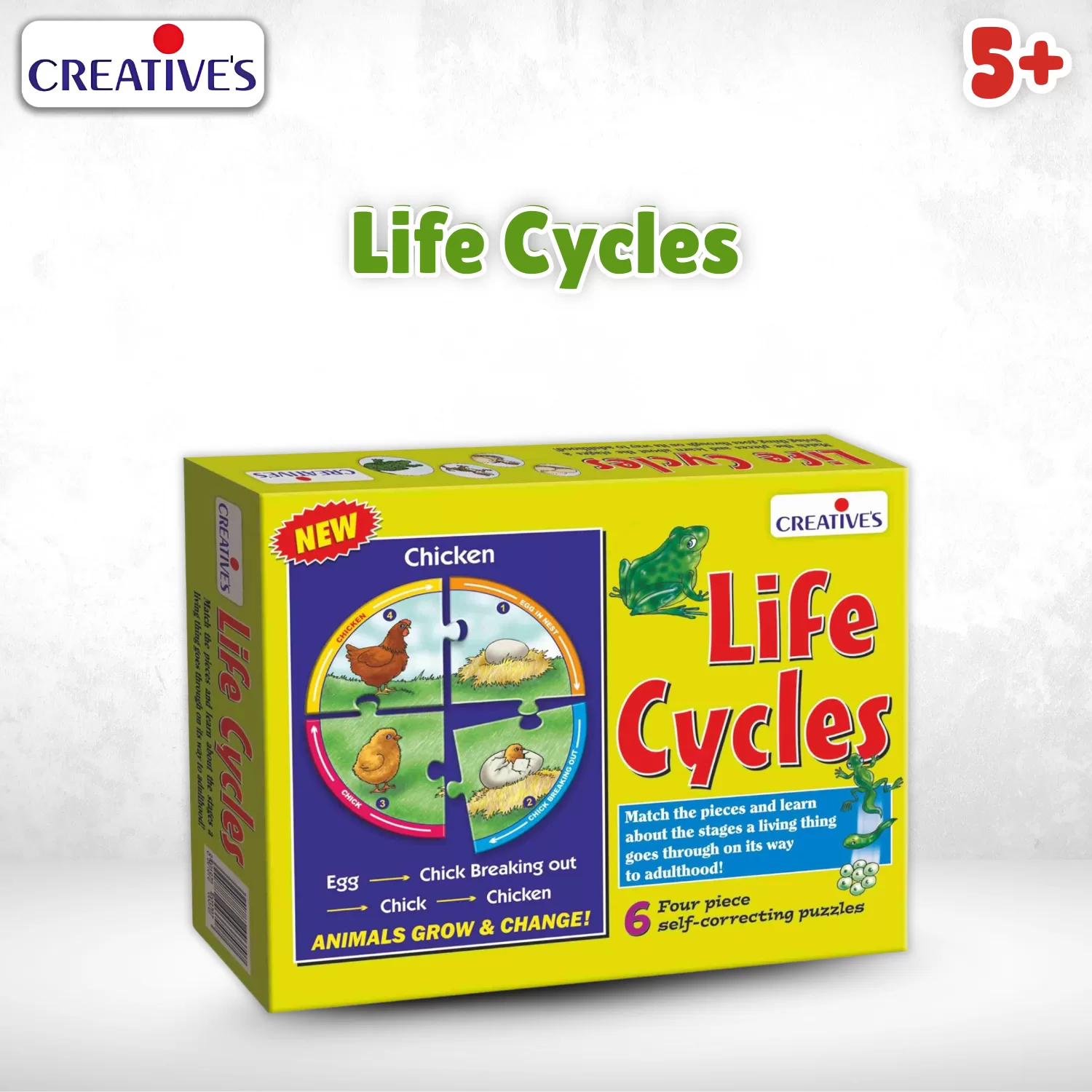
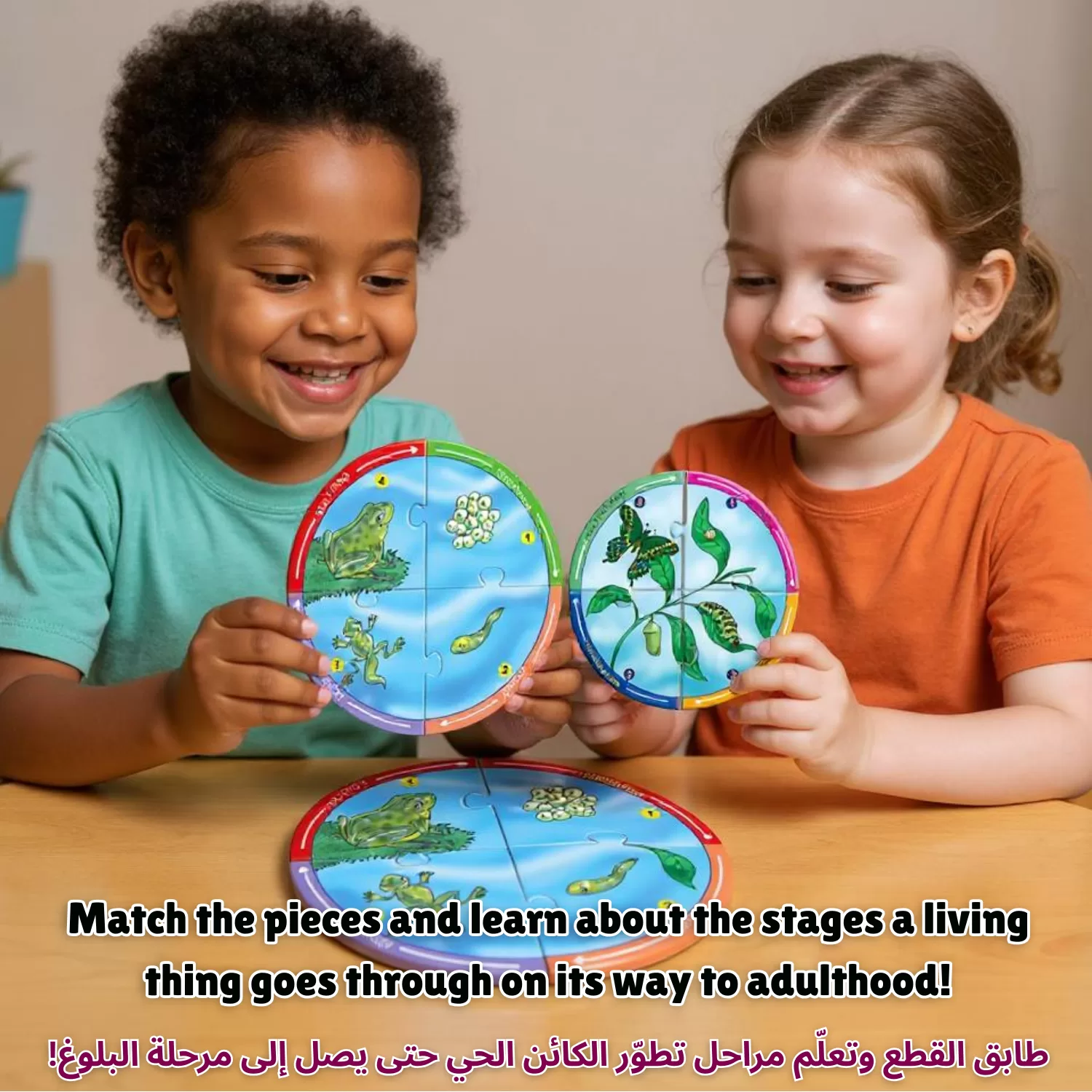
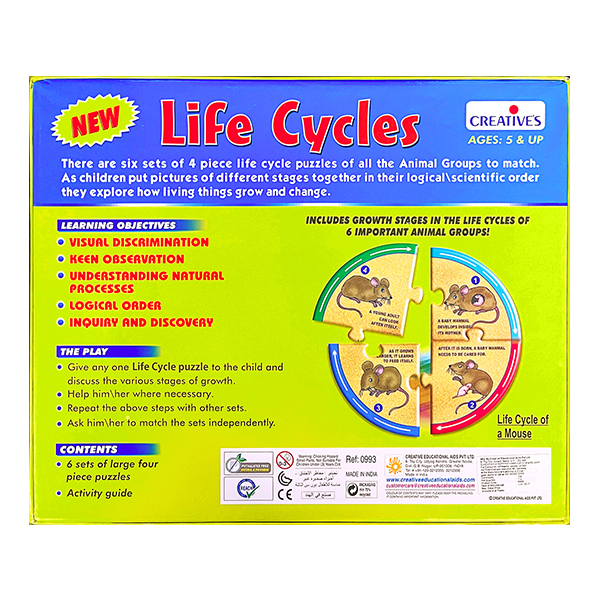
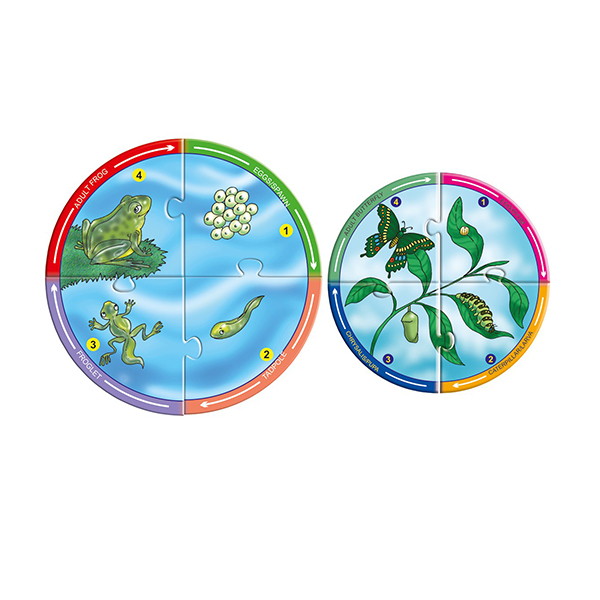
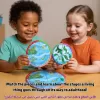
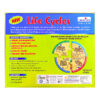
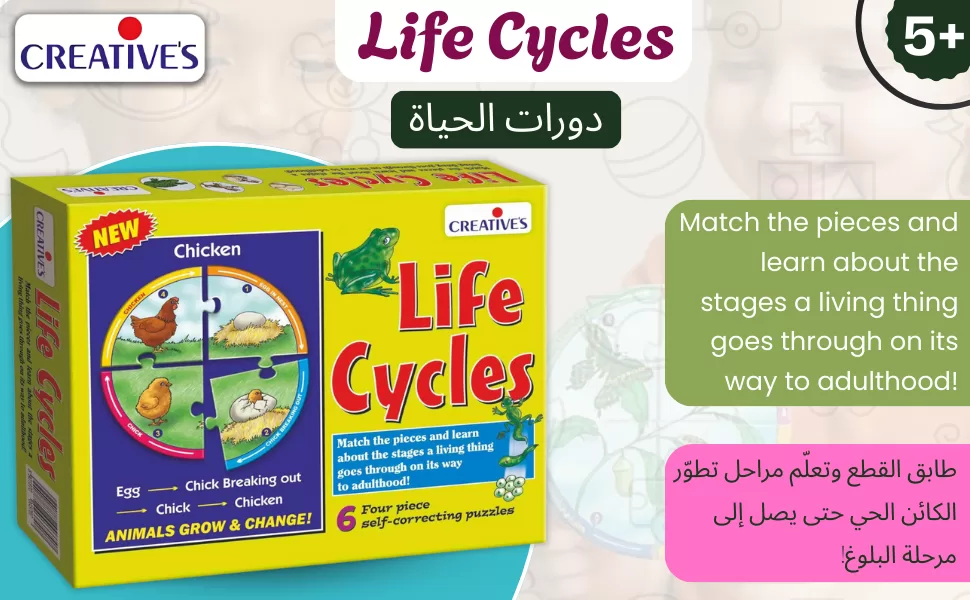
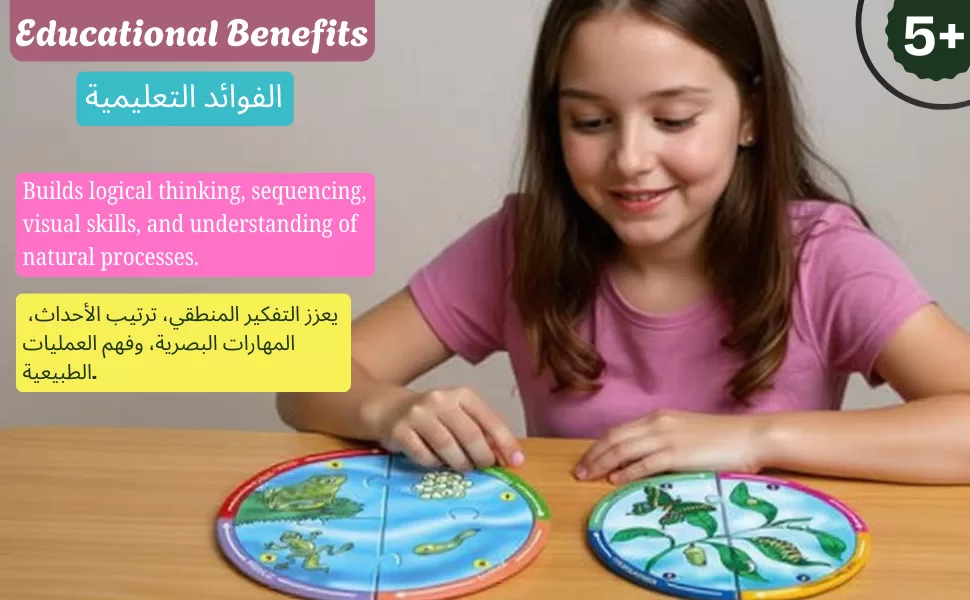
Creative’s Life Cycles is a science puzzle activity for ages 5 and up where children arrange four circular puzzle pieces in the correct biological order to complete the life cycle of six important animal groups egg to chick to chicken, tadpole to frog. Used at home, in primary classrooms, and in early science sessions to build logical thinking and understanding of natural processes.
About This Product
ANIMAL LIFE CYCLES SCIENCE PUZZLE 6 GROUPS AGES 5 AND UP
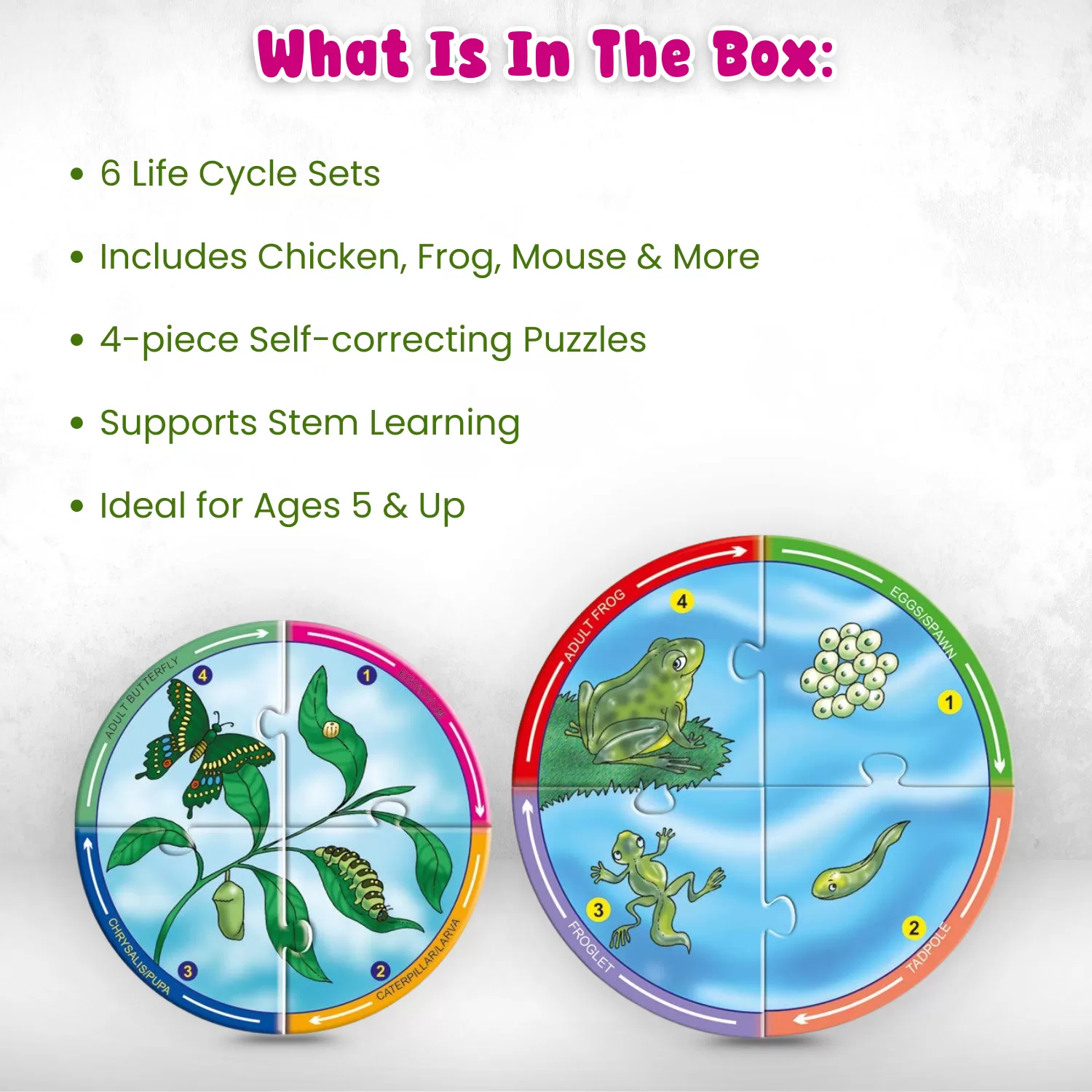
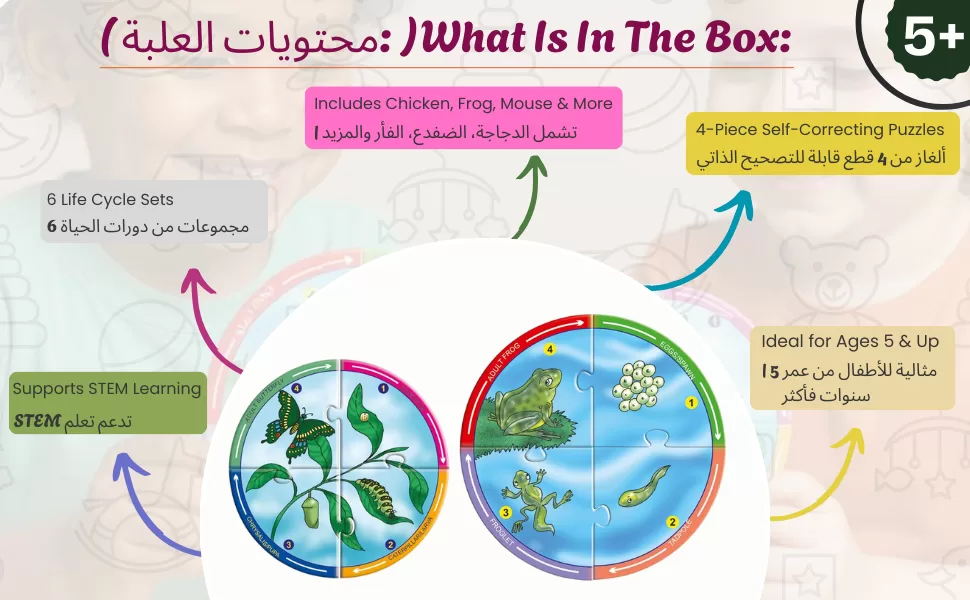
Six circular four-piece puzzles cover the complete growth stages of 6 important animal groups children arrange each stage in correct biological order.
SELF-CORRECTING CIRCULAR PUZZLE FORMAT LOGICAL SCIENTIFIC ORDER
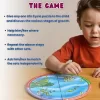
Shaped puzzle pieces only connect in the correct sequence egg, chick breaking out, chick, chicken so children discover the right biological order through reasoning.
BIOLOGY & NATURAL SCIENCE SCREEN-FREE INQUIRY AND DISCOVERY
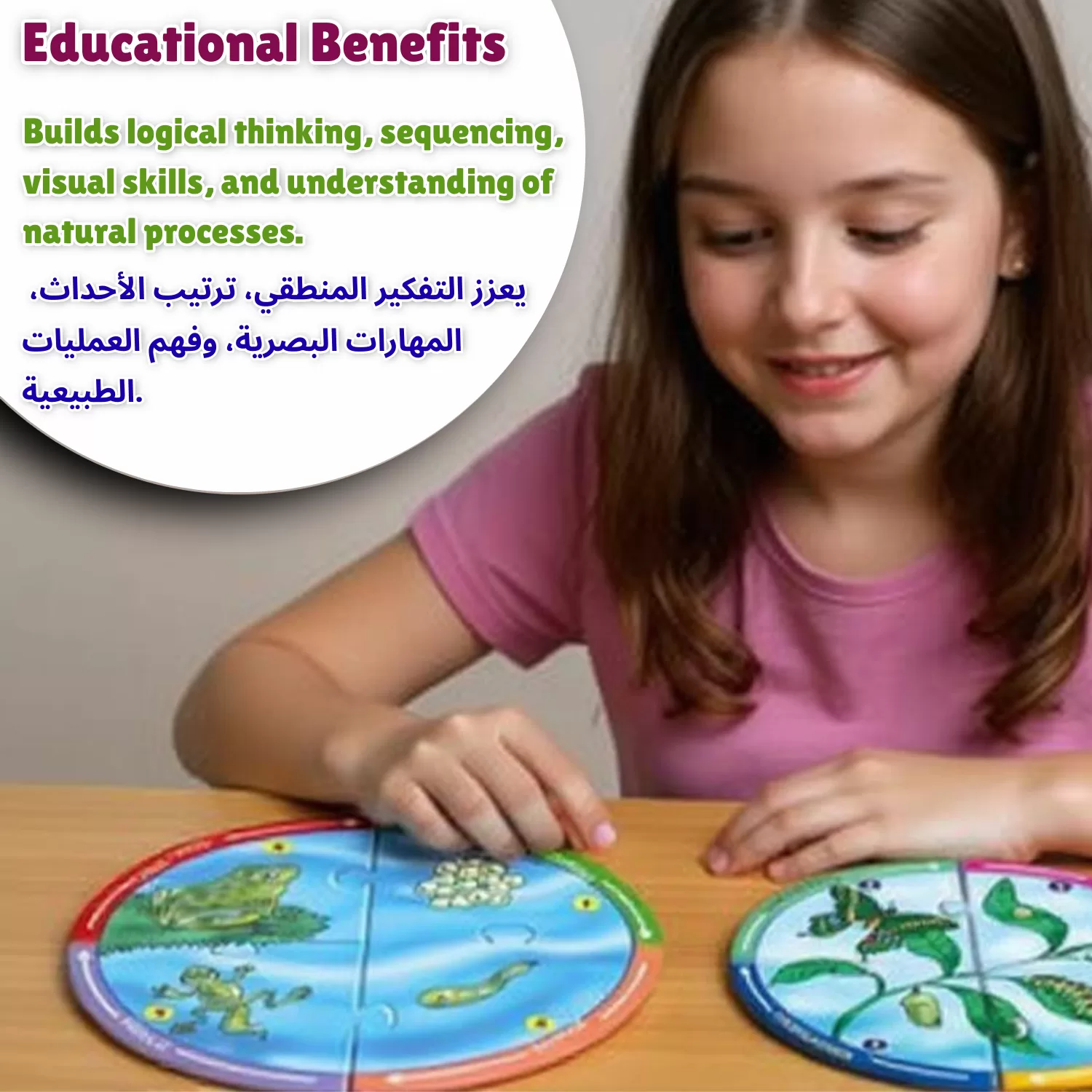
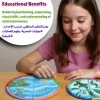
Children explore how living things grow and change across six animal groups, building understanding of natural processes that connects directly to school science curriculum.
HOME & PRIMARY CLASSROOM SCIENCE ACTIVITY SOLO AND GROUP
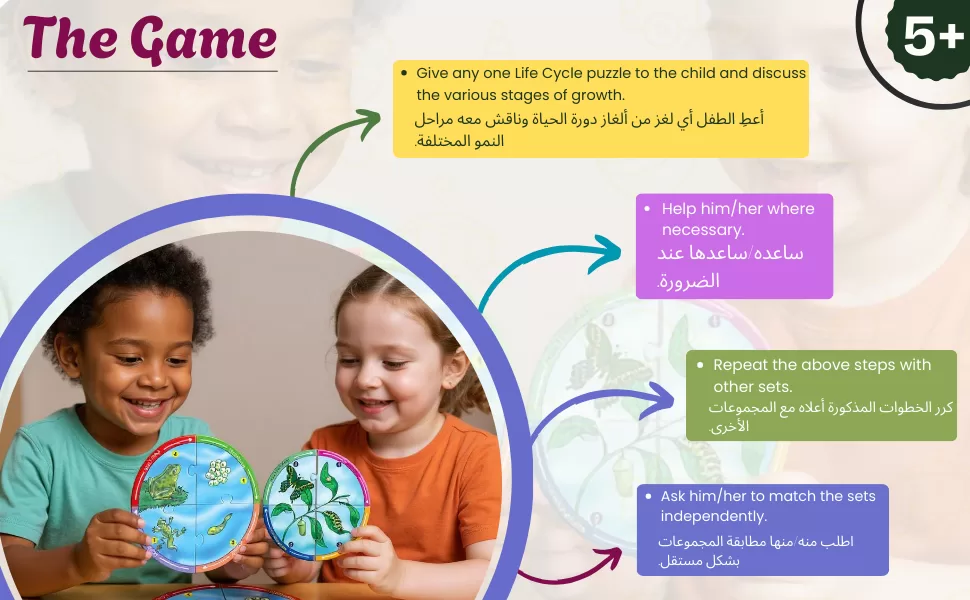
Supports hands-on learning across home, classroom and structured science sessions; activity guide included for discussion-led exploration of each life cycle.
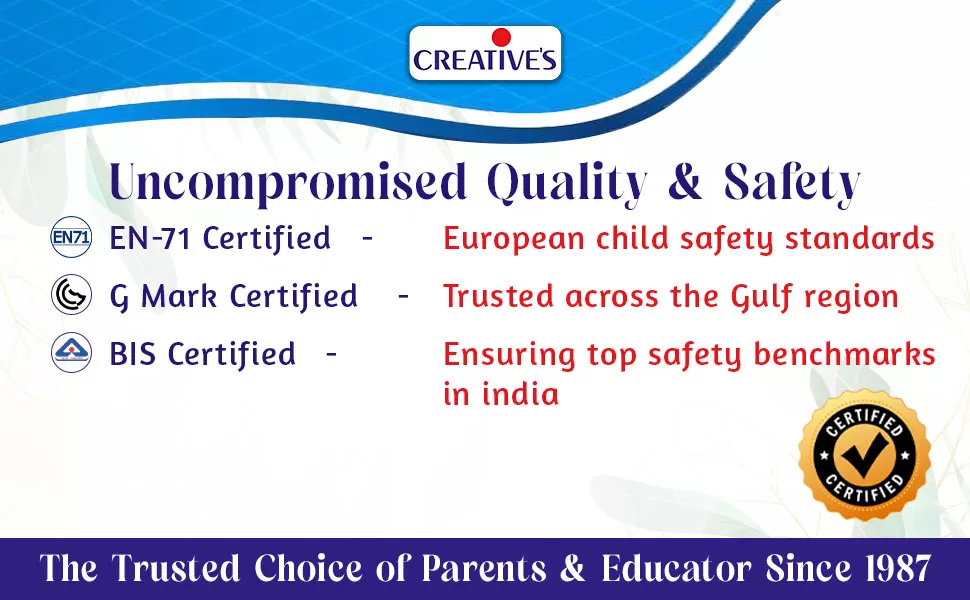
QUALITY, SAFETY & TRUST Creative’s products are proudly made in India, conforming to BIS Safety Standards (IS 9873 – Part 1) and EN71 Part 1, 2 & 3 with European Toy Safety Standards trusted by parents and educators since 1987.
Creative's Life Cycles gives children aged 5 and up six circular four-piece
puzzles — one for each of six important animal groups. Each puzzle
shows the four growth stages of that animal in correct biological order:
for the chicken, egg to chick breaking out to chick to adult; for the mouse,
newborn through dependence to independence to adult. The self-correcting
pieces only connect in the right sequence, so children discover the correct
biological order through reasoning rather than guesswork.
The circular puzzle format makes the concept of a cycle a process that
repeats physically concrete and visually clear. Children place each quarter
piece in turn, discuss what is happening at each stage, and build a complete
picture of how that animal grows and changes.
The activity guide supports structured discovery conversation.
Primary science teachers reach for Life Cycles when starting animal groups
and growth units. Parents choose it because a 5-year-old completing their
first life cycle puzzle independently getting all four stages right builds a
specific kind of scientific confidence that carries into classroom science
from day one.
HOW CHILDREN LEARN
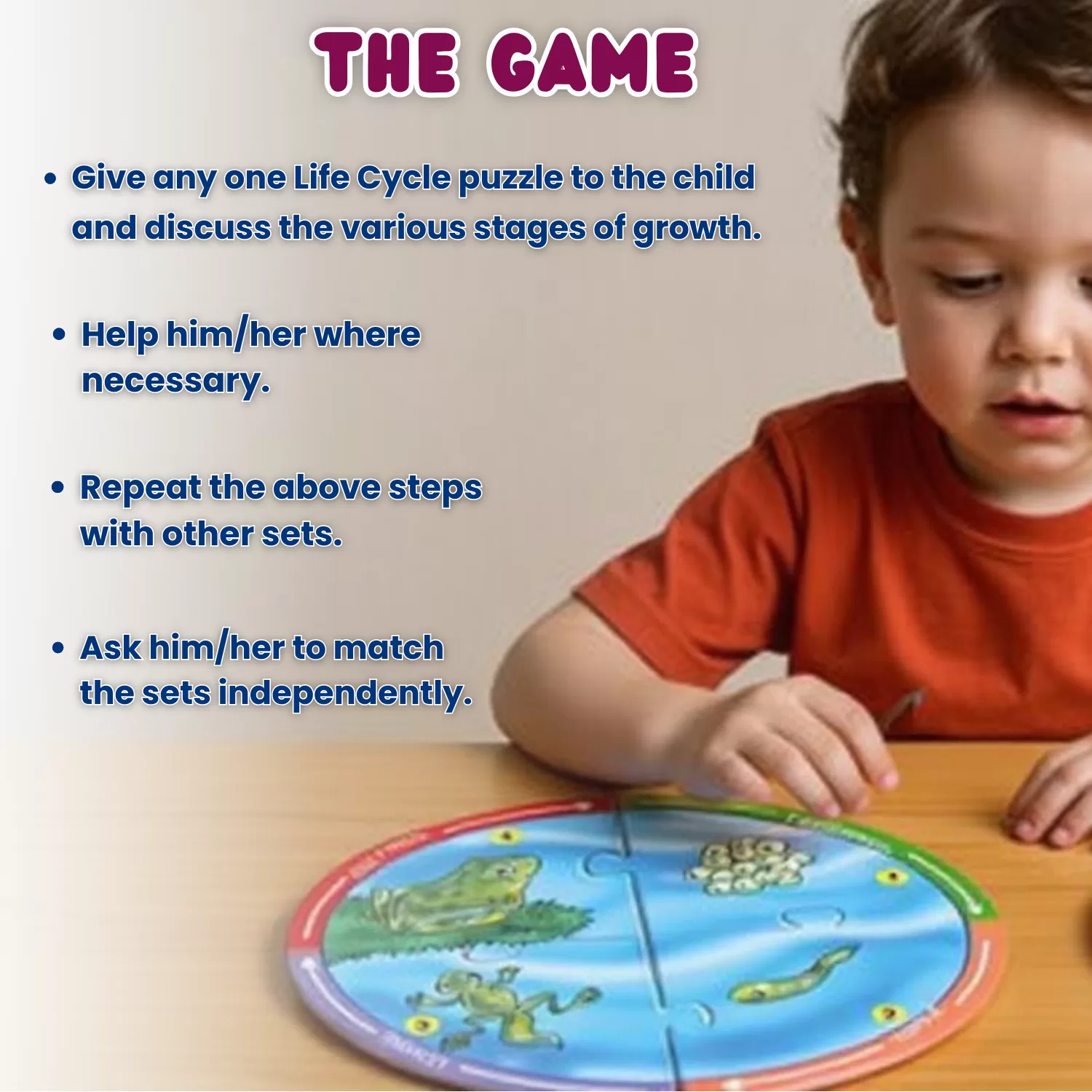
A child picks up the four chicken life cycle pieces and lays them out
placing egg, then chick breaking out, then chick, then chicken in the
circular sequence, discovering the biological order through trial, error,
and the self-correcting puzzle shape.
Comparing the mouse life cycle (mammal born live, cared for by mother)
with the chicken life cycle (bird — hatches from egg) introduces the
concept of different animal groups without a single worksheet.
Discussing each stage as it is placed 'what happens after the egg?'
builds spoken scientific vocabulary and the habit of reasoning through
natural processes in sequence.
Working through all six animal groups independently repeating the
same four-step logical process for each — builds procedural thinking
and the confidence to approach a new problem with a method rather
than a guess.
The circular puzzle format makes the concept of a cycle something
that repeats — visually clear and physically concrete in a way that
diagrams in books rarely achieve for children aged 5 and 6.
Skills Developed
Visual Discrimination
Keen Observation
Understanding Natural Processes
Logical Order & Sequencing
Inquiry & Discovery
Problem Solving
Early Biology & Science Vocabulary
Independent Thinking
WHO IS IT FOR
Children aged 5 and up beginning to learn about animal life cycles,
biological growth stages, and the concept of a natural cycle through
hands-on puzzles.
Parents looking for a science-linked, screen-free activity that builds
logical sequencing and biological vocabulary at home.
Primary school and Year 1 teachers running animal life cycle, animal
groups, or biological growth units as part of early science curriculum.
Homeschooling families covering biology, animal science, or life cycles
as part of a natural science or environmental curriculum.
Special educators who use picture-sequence puzzle formats in structured
and supported science and logical ordering sessions.
After-school science clubs and activity leaders who need a self-correcting,
hands-on biology activity children can complete independently.
PRODUCT FEATURES TABLE
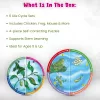
Age Group: 5 Years and Above Players: Solo or Small Group Play Type: Six Four-Piece Circular Self-Correcting Science Puzzles Educational Category: Biology, Life Cycles, Animal Groups, Natural
Science, Logical Sequencing Contents: 6 Sets of Large Four-Piece Puzzles (6 animal groups, 24 pieces total),
Activity Guide Safety Certifications: BIS IS 9873 Part 1, EN71 Part 1, 2 & 3, CE Marked
(Not suitable for children under 3 — choking hazard)
Creative’s Life Cycles gives children aged 5 and up six circular four-piece
puzzles — one for each of six important animal groups. Each puzzle
shows the four growth stages of that animal in correct biological order:
for the chicken, egg to chick breaking out to chick to adult; for the mouse,
newborn through dependence to independence to adult. The self-correcting
pieces only connect in the right sequence, so children discover the correct
biological order through reasoning rather than guesswork.
The circular puzzle format makes the concept of a cycle a process that
repeats physically concrete and visually clear. Children place each quarter
piece in turn, discuss what is happening at each stage, and build a complete
picture of how that animal grows and changes.
The activity guide supports structured discovery conversation.
Primary science teachers reach for Life Cycles when starting animal groups
and growth units. Parents choose it because a 5-year-old completing their
first life cycle puzzle independently getting all four stages right builds a
specific kind of scientific confidence that carries into classroom science
from day one.
HOW CHILDREN LEARN
A child picks up the four chicken life cycle pieces and lays them out
placing egg, then chick breaking out, then chick, then chicken in the
circular sequence, discovering the biological order through trial, error,
and the self-correcting puzzle shape.
Comparing the mouse life cycle (mammal born live, cared for by mother)
with the chicken life cycle (bird — hatches from egg) introduces the
concept of different animal groups without a single worksheet.
Discussing each stage as it is placed ‘what happens after the egg?’
builds spoken scientific vocabulary and the habit of reasoning through
natural processes in sequence.
Working through all six animal groups independently repeating the
same four-step logical process for each — builds procedural thinking
and the confidence to approach a new problem with a method rather
than a guess.
The circular puzzle format makes the concept of a cycle something
that repeats — visually clear and physically concrete in a way that
diagrams in books rarely achieve for children aged 5 and 6.
Skills Developed
Visual Discrimination
Keen Observation
Understanding Natural Processes
Logical Order & Sequencing
Inquiry & Discovery
Problem Solving
Early Biology & Science Vocabulary
Independent Thinking
WHO IS IT FOR
Children aged 5 and up beginning to learn about animal life cycles,
biological growth stages, and the concept of a natural cycle through
hands-on puzzles.
Parents looking for a science-linked, screen-free activity that builds
logical sequencing and biological vocabulary at home.
Primary school and Year 1 teachers running animal life cycle, animal
groups, or biological growth units as part of early science curriculum.
Homeschooling families covering biology, animal science, or life cycles
as part of a natural science or environmental curriculum.
Special educators who use picture-sequence puzzle formats in structured
and supported science and logical ordering sessions.
After-school science clubs and activity leaders who need a self-correcting,
hands-on biology activity children can complete independently.
PRODUCT FEATURES TABLE
Age Group: 5 Years and Above Players: Solo or Small Group Play Type: Six Four-Piece Circular Self-Correcting Science Puzzles Educational Category: Biology, Life Cycles, Animal Groups, Natural
Science, Logical Sequencing Contents: 6 Sets of Large Four-Piece Puzzles (6 animal groups, 24 pieces total),
Activity Guide Safety Certifications: BIS IS 9873 Part 1, EN71 Part 1, 2 & 3, CE Marked
(Not suitable for children under 3 — choking hazard)