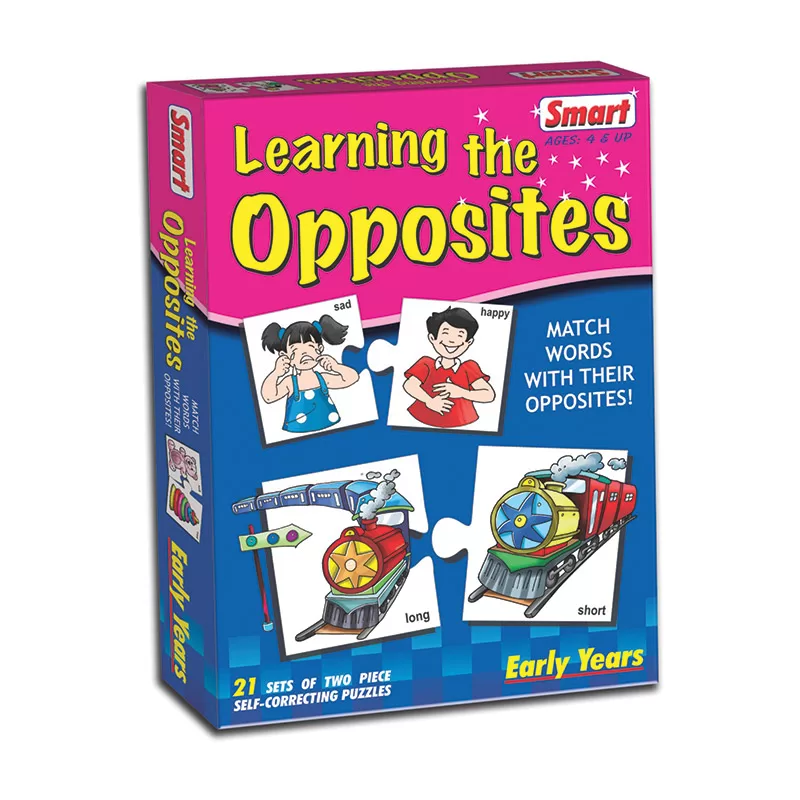
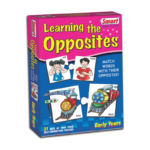
Smart Learning the Opposites gives children aged 4 & up 21 self-correcting two-piece puzzles to match illustrated opposite word pairs sad/happy, long/short and more. Builds vocabulary, word comprehension and language thinking through vivid, hands-on picture-word matching play.
About This Product
OPPOSITES WORD MATCHING PUZZLE 21 self-correcting two-piece sets pair illustrated opposite concepts sad/happy, long/short and more.
PICTURE-WORD PAIRING MECHANIC Each piece shows a vivid illustration with its word label — children match concept to concept through visual and language cues.
SCREEN-FREE VOCABULARY BUILDING Tactile puzzle format makes abstract language concepts concrete and memorable without screens.
HOME, CLASSROOM & THERAPY USE Supports structured vocabulary and language learning across home, school and therapy-friendly environments.
QUALITY, SAFETY & TRUST Smart products are proudly made in India, conforming to BIS Safety Standards (IS 9873 – Part 1) and EN71 Part 1, 2 & 3 with European Toy Safety Standards trusted by parents and educators since 1987.
Smart Learning the Opposites is a 21-set, two-piece self-correcting
puzzle that teaches children aged 4 and up to identify and pair
opposite concepts through vivid illustrated picture-word cards.
Each puzzle piece shows an illustration alongside its word sad,
happy, long, short and children match each word to its opposite
to complete the pair. The self-correcting jigsaw design confirms
every correct match instantly, so children build vocabulary and
concept understanding with complete independence. Covering 21
opposite pairs across emotional, physical and descriptive concepts,
the set gives children a rich and varied language foundation that
extends well beyond the puzzle itself. Parents and teachers choose
this set because it makes abstract language relationships words l
ike opposite and contrast immediately concrete through pictures.
Often used in structured play and therapy-friendly learning settings,
it is self-directed, durable and effective across home, classroom and
one-to-one formats.
HOW CHILDREN LEARN
A child picks up the 'sad' piece showing the crying girl and
searches for 'happy' connecting the two images and
internalising the relationship between the words and
their meanings.
The self-correcting jigsaw edge confirms every correct
match children learn the opposite pair with immediate,
independent feedback and no adult checking required.
Reading the word label on each piece alongside the illustration
builds early word recognition and links printed language to
meaning naturally during play.
Working through all 21 opposite pairs from emotional
states like sad/happy to physical properties like long/short
builds a wide and varied vocabulary of contrasting concepts.
Discussing each completed pair with a parent or teacher extends
the activity into conversation, encouraging children to use
opposite words in their own sentences.
SKILLS DEVELOPED
Vocabulary Development Opposites
Language Comprehension
Word Recognition
Visual Discrimination
Matching Skills
Logical Thinking
Concentration & Focus
WHO IS IT FOR
Parents building opposite word vocabulary and language
comprehension with children aged 4 to 7 at home.
Preschool and kindergarten teachers running vocabulary and
early literacy activities in the classroom.
Speech and language therapists using illustrated word-matching
to build expressive language and concept understanding.
Special educators using self-correcting picture-word pairs in
structured, therapy-supported vocabulary sessions.
Homeschooling families looking for a self-directed early
language resource covering opposites and antonyms.
Learning centres stocking hands-on vocabulary development
activities for early years language groups.
PRODUCT FEATURES
Age Group: 4 Years & Up Players: 1 or more (individual or group play) Play Type: Two-Piece Self-Correcting Picture Word Matching Puzzle Educational Category: Language Development
• Vocabulary • Opposites Contents: 21 Sets of Two-Piece Self-Correcting Puzzles Concept Pairs: Emotional, physical and descriptive opposites
e.g. sad/happy • long/short Safety Certifications: BIS IS 9873 (Part 1)
• EN71 Part 1, 2 & 3 • CE Marked
Smart Learning the Opposites is a 21-set, two-piece self-correcting
puzzle that teaches children aged 4 and up to identify and pair
opposite concepts through vivid illustrated picture-word cards.
Each puzzle piece shows an illustration alongside its word sad,
happy, long, short and children match each word to its opposite
to complete the pair. The self-correcting jigsaw design confirms
every correct match instantly, so children build vocabulary and
concept understanding with complete independence. Covering 21
opposite pairs across emotional, physical and descriptive concepts,
the set gives children a rich and varied language foundation that
extends well beyond the puzzle itself. Parents and teachers choose
this set because it makes abstract language relationships words l
ike opposite and contrast immediately concrete through pictures.
Often used in structured play and therapy-friendly learning settings,
it is self-directed, durable and effective across home, classroom and
one-to-one formats.
HOW CHILDREN LEARN
A child picks up the ‘sad’ piece showing the crying girl and
searches for ‘happy’ connecting the two images and
internalising the relationship between the words and
their meanings.
The self-correcting jigsaw edge confirms every correct
match children learn the opposite pair with immediate,
independent feedback and no adult checking required.
Reading the word label on each piece alongside the illustration
builds early word recognition and links printed language to
meaning naturally during play.
Working through all 21 opposite pairs from emotional
states like sad/happy to physical properties like long/short
builds a wide and varied vocabulary of contrasting concepts.
Discussing each completed pair with a parent or teacher extends
the activity into conversation, encouraging children to use
opposite words in their own sentences.
SKILLS DEVELOPED
Vocabulary Development Opposites
Language Comprehension
Word Recognition
Visual Discrimination
Matching Skills
Logical Thinking
Concentration & Focus
WHO IS IT FOR
Parents building opposite word vocabulary and language
comprehension with children aged 4 to 7 at home.
Preschool and kindergarten teachers running vocabulary and
early literacy activities in the classroom.
Speech and language therapists using illustrated word-matching
to build expressive language and concept understanding.
Special educators using self-correcting picture-word pairs in
structured, therapy-supported vocabulary sessions.
Homeschooling families looking for a self-directed early
language resource covering opposites and antonyms.
Learning centres stocking hands-on vocabulary development
activities for early years language groups.
PRODUCT FEATURES
Age Group: 4 Years & Up Players: 1 or more (individual or group play) Play Type: Two-Piece Self-Correcting Picture Word Matching Puzzle Educational Category: Language Development
• Vocabulary • Opposites Contents: 21 Sets of Two-Piece Self-Correcting Puzzles Concept Pairs: Emotional, physical and descriptive opposites
e.g. sad/happy • long/short Safety Certifications: BIS IS 9873 (Part 1)
• EN71 Part 1, 2 & 3 • CE Marked
Good educational toy for young kids. Great for early learning at home—simple, interactive, and effective. Good value for money; quality is better than expected.






Good educational toy for young kids. Great for early learning at home—simple, interactive, and effective. Good value for money; quality is better than expected.