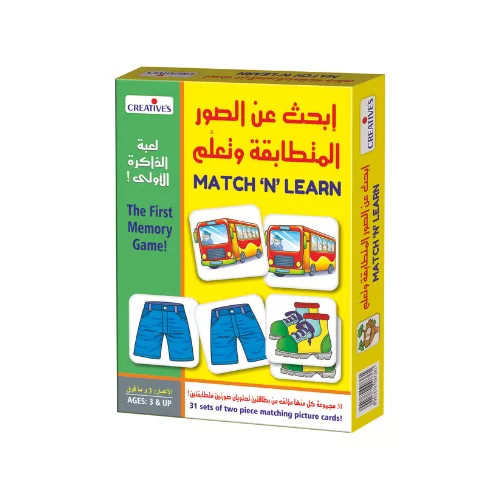

Description
Creative’s Heads & Tails is a picture-matching activity for children
aged 2½ and above. Each of the 10 familiar objects animals, vehicles
and everyday things — is split across two large cards. Children scan
the spread-out halves, identify the correct match and join them together
to reveal the complete picture. The large, sturdy cards are sized specifically
for young hands, making independent play achievable from the very
first session.
The activity runs in two stages: first, children match the correct head and
tail halves; then, they name each object and talk about its colour, shape
and size. This guided conversation layer built into the activity instructions
extends simple matching into meaningful language development and
early descriptive thinking.
Parents and teachers choose Heads & Tails because it works equally well
at a kitchen table, in a nursery setting, or as part of structured play and
therapy-friendly learning sessions. The bilingual English and Arabic
format makes it a practical choice for multilingual families and international
schools, and the 10-object set provides enough variety to keep sessions
fresh across many play sessions.
HOW CHILDREN LEARN
- A child spreads all 20 large cards face-up, scans the images and
immediately begins grouping by colour observation and sorting
skills engage before a single match is made. - Picking up, rotating and pressing two halves together trains grip
strength, hand-eye coordination and spatial awareness in a natural,
low-frustration format. - Each time a head and tail connect correctly, a child experiences a
clear, visible result — immediate feedback that builds confidence
and motivates the next match. - An adult names each completed object in English and Arabic,
turning every successful match into a two-language vocabulary
moment. - Discussing colour, shape and size of each matched object as the
activity prompts introduces early descriptive language and
comparative thinking.
SKILLS DEVELOPED
Observation | Visual Discrimination | Matching Skills | Problem Solving
| Hand-Eye Coordination | Language Development | Cognitive Development
WHO IS IT FOR
- Toddlers aged 2½–4 building their first matching and observation skills.
- Parents looking for a screen-free, language-rich activity that works from age 2½.
- Nursery and preschool teachers wanting a structured matching
activity with a conversation component. - Caregivers in bilingual English/Arabic households wanting vocabulary
building play for very young children. - Occupational therapists and early intervention practitioners seeking
large-piece matching activities for structured sessions. - Gift-givers wanting an age-appropriate, educator-trusted activity for
a child aged 2½ to 4.