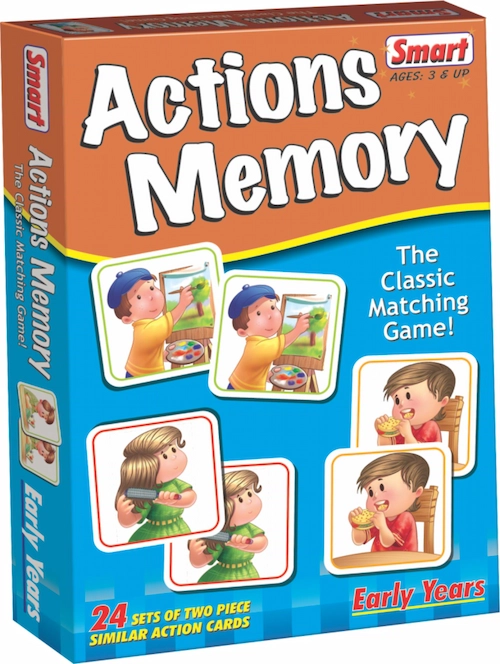
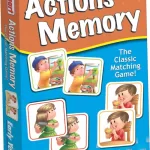
Smart Actions Memory is a classic picture-pair memory game for ages 3 and up with a twist 24 pairs of similar action scene cards that challenge children to spot identical illustrations among very similar images. No reading required; builds visual discrimination, keen observation, logical thinking, and memory skills through close-looking play.
About This Product
ACTIONS MEMORY SIMILAR PICTURE MATCHING GAME AGES 3 24 pairs of similar action scene cards children painting, eating, jumping, dancing each pair requires careful looking to identify the identical match.
VISUAL DISCRIMINATION HARDER THAN STANDARD MEMORY Pairs show similar but not identical illustrations; children must observe closely to find the true match, building a more demanding level of visual discrimination.
NO READING SKILLS REQUIRED Matching is entirely visual no words, no numbers, no literacy barrier making this accessible to all children from age 3 regardless of reading level.
SCREEN-FREE OBSERVATION & LOGICAL THINKING GAME Developed with Early Learning Consultants; builds visual discrimination, memory skills, problem solving, keen observation, and matching skills simultaneously.
QUALITY, SAFETY & TRUST Smart Early Years products are proudly made in India, conforming to CE Mark safety standards trusted by parents and educators as part of the Early Years Series.
Smart Actions Memory takes the classic memory matching game and
makes it harder — in the most developmentally useful way possible.
Rather than identical picture pairs, the 24 pairs show similar action
scenes: children painting, eating, playing, jumping, and writing in
illustrations where careful observation is needed to identify the
true matching pair. No reading is required, making this accessible
to all children from age 3 regardless of literacy level.
The classic face-down format applies: all 48 cards face-down, flip
two at a time, collect matching pairs, return non-matching cards.
The similarity between cards means children cannot rely on vague
visual recall — they must encode specific details about what they
saw, and then recognise those same details when they see the card
again. The included Activity Guide extends the cards into additional
observation and matching games beyond the basic memory format.
Parents and teachers choose Actions Memory because it builds a more
demanding level of visual discrimination than standard memory games
the kind of precise close-looking that supports early reading, writing,
and maths through the same play session.
It is often used in structured play and therapy-friendly learning
settings for visual perception, logical thinking, and sustained attention
development. Developed in association with Early Learning Consultants.
How Children Learn
A child flips over a card showing a boy eating with a spoon
the task is not just to find the matching picture, but to find
the identical version among several similar-looking cards
showing children in comparable poses. This forces genuinely
focused looking rather than casual glancing.
When two cards appear almost the same but differ in a small
detail a different background colour, a slightly different arm
position, a changed expression children learn to look
systematically rather than impulsively.
This precision of observation is directly transferable to
reading letter shapes and number forms.
The action theme painting, eating, jumping, writing introduces
action vocabulary naturally. Children describe what they see as
they search ('the one who is painting'), building descriptive
language and verb vocabulary through motivated conversation.
In the classic face-down format, children must remember not
just where a card was, but which of the similar-looking cards it
was a harder recall task than standard identical-picture memory
because visual similarity requires more precise encoding
of what was seen.
Playing across multiple sessions, children notice themselves
distinguishing similar cards faster the improvement in their
ability to spot fine visual differences is visible and motivating,
building the confidence and logical thinking the game is designed to develop.
Skills Developed
Visual Discrimination
Memory Skills
Problem Solving
Keen Observation
Matching Skills
Logical Thinking
Language Development & Action Vocabulary
Who Is It For
Children aged 3 and above who are ready to move beyond simple
identical-picture matching to more demanding similar-image
discrimination.
Parents looking for a memory game that genuinely challenges a
child's observation skills rather than just relying on luck.
Nursery and reception teachers using visual discrimination
activities for observation, sustained attention, and logical thinking.
Occupational therapists using visual discrimination and close-observation
card activities for perceptual and cognitive development.
Parents of children who find standard memory games too easy
the similar-picture format raises the difficulty without changing
the rules.
Gift-buyers looking for a more challenging alternative to standard
memory games for a child aged 3 to 7.
PRODUCT FEATURES
Age Group: 3 Years & Above Number of Players: 2 or more Play Type: Visual Discrimination Memory Matching Card Game Educational Category: Visual Discrimination • Observation • Memory • Logical Thinking Contents:
24 Sets of Two-Piece Similar Action Cards (48 cards total) • Activity Guide Card Theme: Children performing actions painting, eating, jumping, dancing,
writing and more Key Differentiator: Cards are similar, not identical children must observe closely
to find the true matching pair Special Feature: No reading or number skills required accessible to all children from age 3 Developed With: Early Learning Consultants Brand: Smart Early Years Series (published by Smart Playthings Pvt Ltd) Safety Certifications: CE Mark Reference Number: 01080
Smart Actions Memory takes the classic memory matching game and
makes it harder — in the most developmentally useful way possible.
Rather than identical picture pairs, the 24 pairs show similar action
scenes: children painting, eating, playing, jumping, and writing in
illustrations where careful observation is needed to identify the
true matching pair. No reading is required, making this accessible
to all children from age 3 regardless of literacy level.
The classic face-down format applies: all 48 cards face-down, flip
two at a time, collect matching pairs, return non-matching cards.
The similarity between cards means children cannot rely on vague
visual recall — they must encode specific details about what they
saw, and then recognise those same details when they see the card
again. The included Activity Guide extends the cards into additional
observation and matching games beyond the basic memory format.
Parents and teachers choose Actions Memory because it builds a more
demanding level of visual discrimination than standard memory games
the kind of precise close-looking that supports early reading, writing,
and maths through the same play session.
It is often used in structured play and therapy-friendly learning
settings for visual perception, logical thinking, and sustained attention
development. Developed in association with Early Learning Consultants.
How Children Learn
A child flips over a card showing a boy eating with a spoon
the task is not just to find the matching picture, but to find
the identical version among several similar-looking cards
showing children in comparable poses. This forces genuinely
focused looking rather than casual glancing.
When two cards appear almost the same but differ in a small
detail a different background colour, a slightly different arm
position, a changed expression children learn to look
systematically rather than impulsively.
This precision of observation is directly transferable to
reading letter shapes and number forms.
The action theme painting, eating, jumping, writing introduces
action vocabulary naturally. Children describe what they see as
they search (‘the one who is painting’), building descriptive
language and verb vocabulary through motivated conversation.
In the classic face-down format, children must remember not
just where a card was, but which of the similar-looking cards it
was a harder recall task than standard identical-picture memory
because visual similarity requires more precise encoding
of what was seen.
Playing across multiple sessions, children notice themselves
distinguishing similar cards faster the improvement in their
ability to spot fine visual differences is visible and motivating,
building the confidence and logical thinking the game is designed to develop.
Skills Developed
Visual Discrimination
Memory Skills
Problem Solving
Keen Observation
Matching Skills
Logical Thinking
Language Development & Action Vocabulary
Who Is It For
Children aged 3 and above who are ready to move beyond simple
identical-picture matching to more demanding similar-image
discrimination.
Parents looking for a memory game that genuinely challenges a
child’s observation skills rather than just relying on luck.
Nursery and reception teachers using visual discrimination
activities for observation, sustained attention, and logical thinking.
Occupational therapists using visual discrimination and close-observation
card activities for perceptual and cognitive development.
Parents of children who find standard memory games too easy
the similar-picture format raises the difficulty without changing
the rules.
Gift-buyers looking for a more challenging alternative to standard
memory games for a child aged 3 to 7.
PRODUCT FEATURES
Age Group: 3 Years & Above Number of Players: 2 or more Play Type: Visual Discrimination Memory Matching Card Game Educational Category: Visual Discrimination • Observation • Memory • Logical Thinking Contents:
24 Sets of Two-Piece Similar Action Cards (48 cards total) • Activity Guide Card Theme: Children performing actions painting, eating, jumping, dancing,
writing and more Key Differentiator: Cards are similar, not identical children must observe closely
to find the true matching pair Special Feature: No reading or number skills required accessible to all children from age 3 Developed With: Early Learning Consultants Brand: Smart Early Years Series (published by Smart Playthings Pvt Ltd) Safety Certifications: CE Mark Reference Number: 01080
Works perfectly for our daily play time. The pieces/cards are easy to hold and the printing is bright and clear. A smart screen-free activity that keeps kids busy and parents relaxed.







Works perfectly for our daily play time. The pieces/cards are easy to hold and the printing is bright and clear. A smart screen-free activity that keeps kids busy and parents relaxed.