
Unlock 15% OFF – Use Code SPECIAL15 Now!
Welcome to Creative Educational aids
Use Code SPECIAL15 & Save 15% Instantly!
Previous
Creative's- Heads & Tails

Creative’s Heads & Tails Matching Puzzle for Toddlers | Ages 2.5+

315.00
Next

Creative’s Science Knowledge Boosters Human Body Learning Game 6+

315.00
Creative's- Science Knowledge Booster (Human Body)

Creative’s What’s the Difference? Sequential Picture Game Ages 3+

325.00

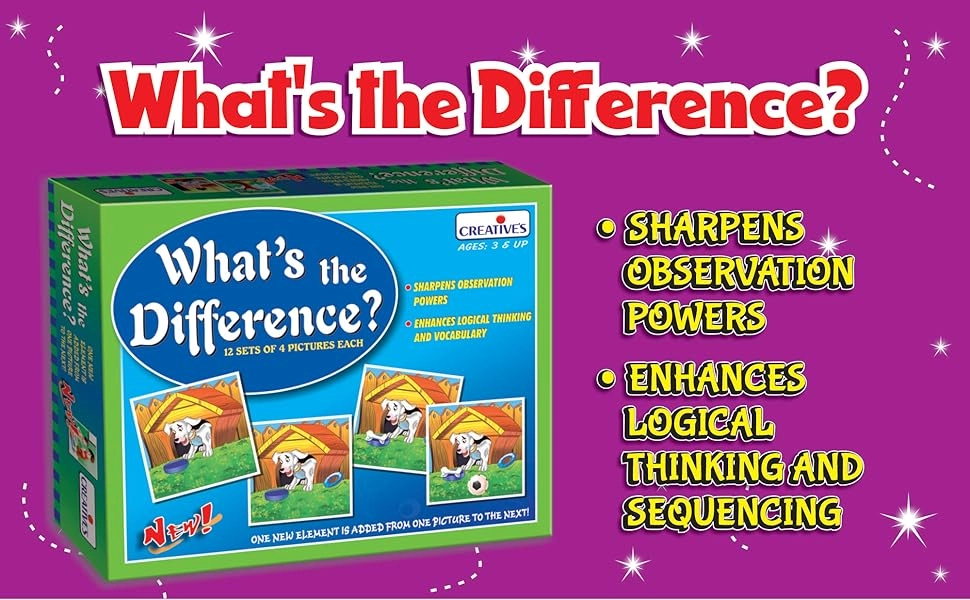
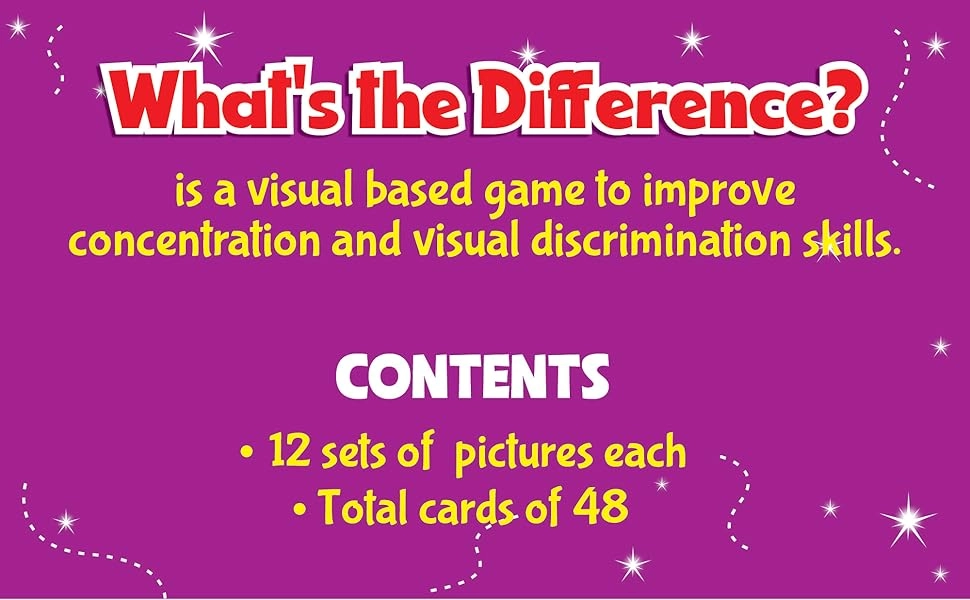
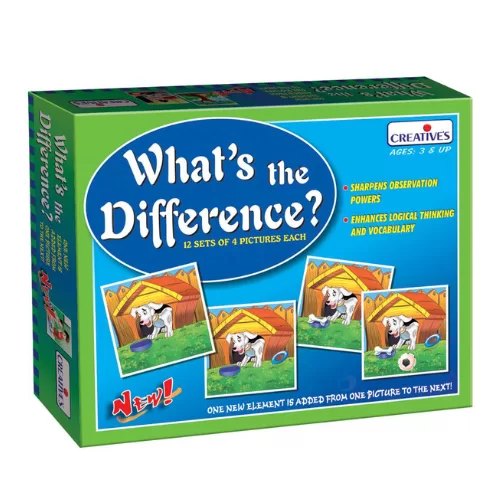
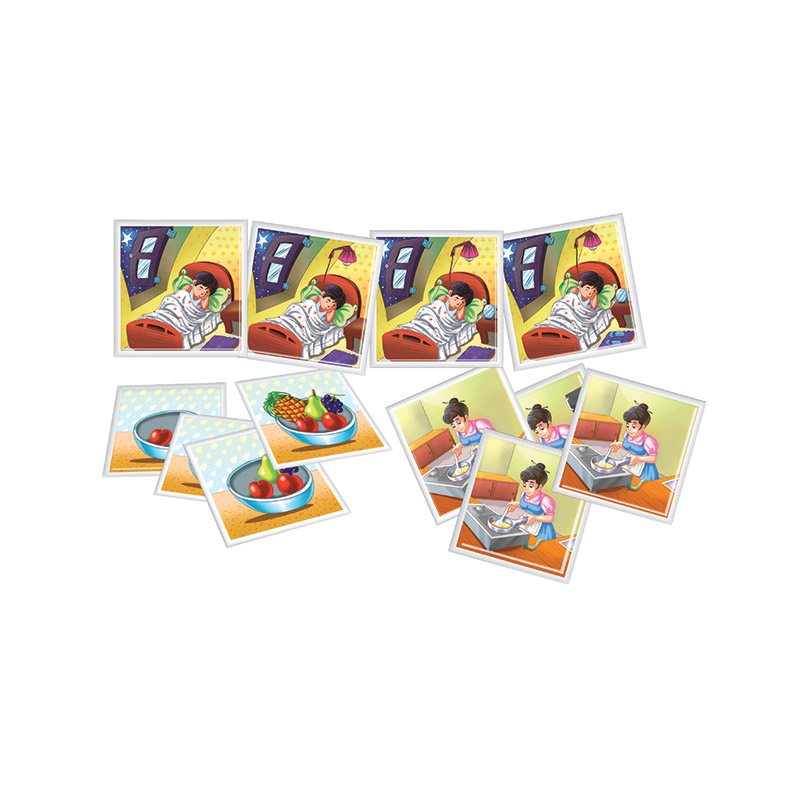
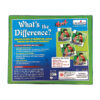
Creative’s What’s the Difference? is a sequential picture card game where one new element is added from card to card across 12 sets of four pictures, building observation, logical thinking, language, and perception in children from age 3. Used at home, in early years classrooms, and in structured play and therapy-friendly learning settings.

About This Product

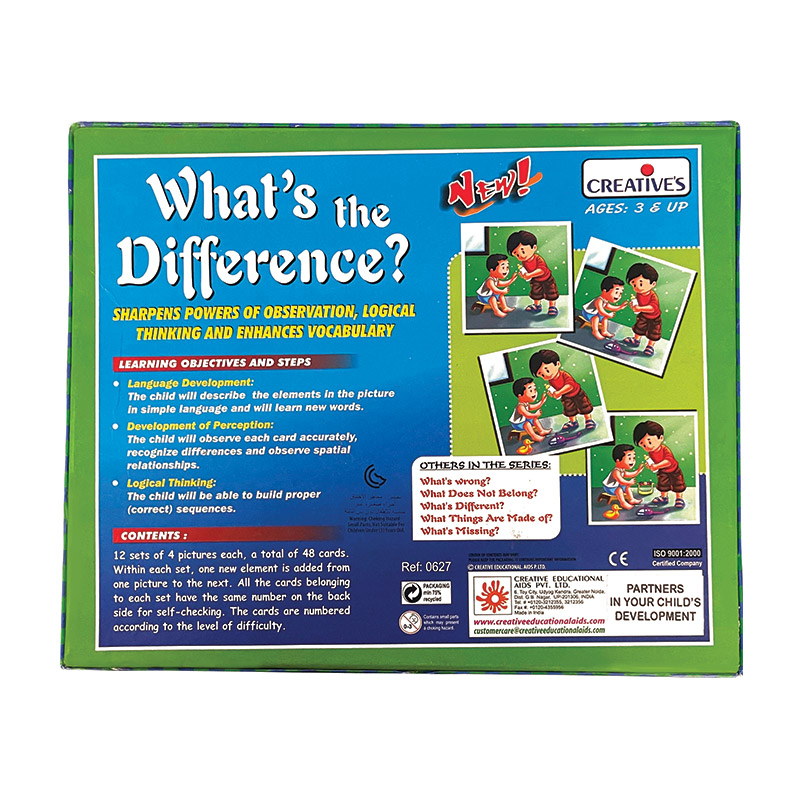
  • SEQUENTIAL PICTURE CARD GAME LOGICAL THINKING AGES 3 —
    Each set of 4 cards builds progressively — one new element is added from picture to picture, training children to track change and build correct sequences.
  • SPOT WHAT’S ADDED OBSERVATION SKILLS CARD GAME —
    Unlike find-the-difference games, children must identify what has been added in each picture, sharpening forward-looking observation and spatial awareness across 12 illustrated scenes.
  • SCREEN-FREE VOCABULARY & LANGUAGE DEVELOPMENT ACTIVITY —
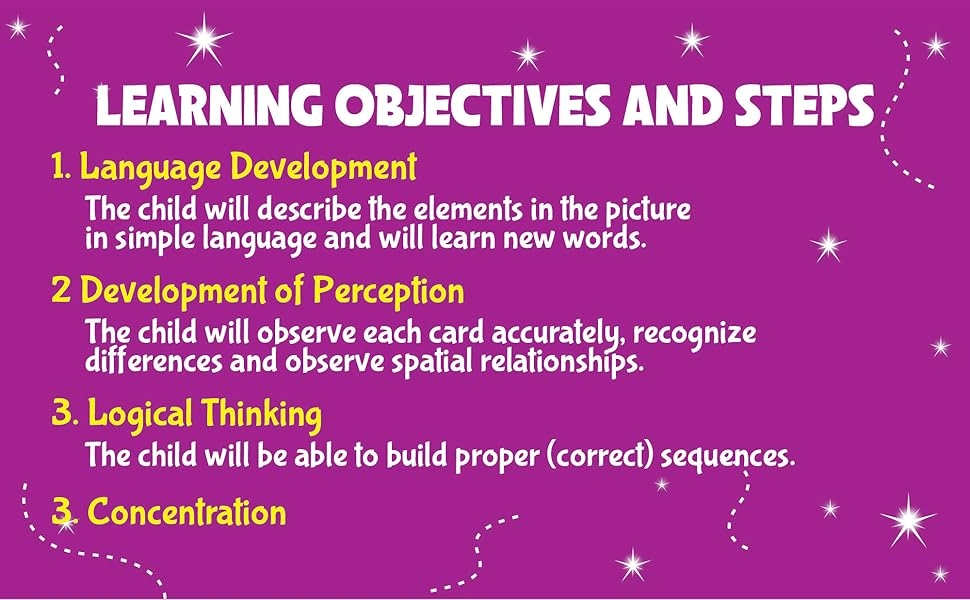
    No batteries or screens — children describe each picture in their own words, learn new vocabulary naturally, and build sentences as they explain each new addition.
  • EARLY YEARS PERCEPTION & SEQUENCING HOME CLASSROOM GAME —
    Often used in structured play and therapy-friendly learning settings; supports hands-on learning across home, classroom and therapy environments.
  • QUALITY, SAFETY & TRUST —
    Creative’s products are proudly made in India, conforming to BIS Safety Standards (IS 9873 – Part 1) and EN71 Part 1, 2 & 3 with European Toy Safety Standards trusted by parents and educators since 1987.

Creative’s What’s the Difference? is a sequential picture card game from
the Early Memory Games series with a mechanic that sets it apart from
standard spot-the-difference games. Across 12 sets of four illustrated
cards, one new element is added from picture to picture. Children aged
3 and up must identify what has been added at each step and arrange the
cards in the correct order.

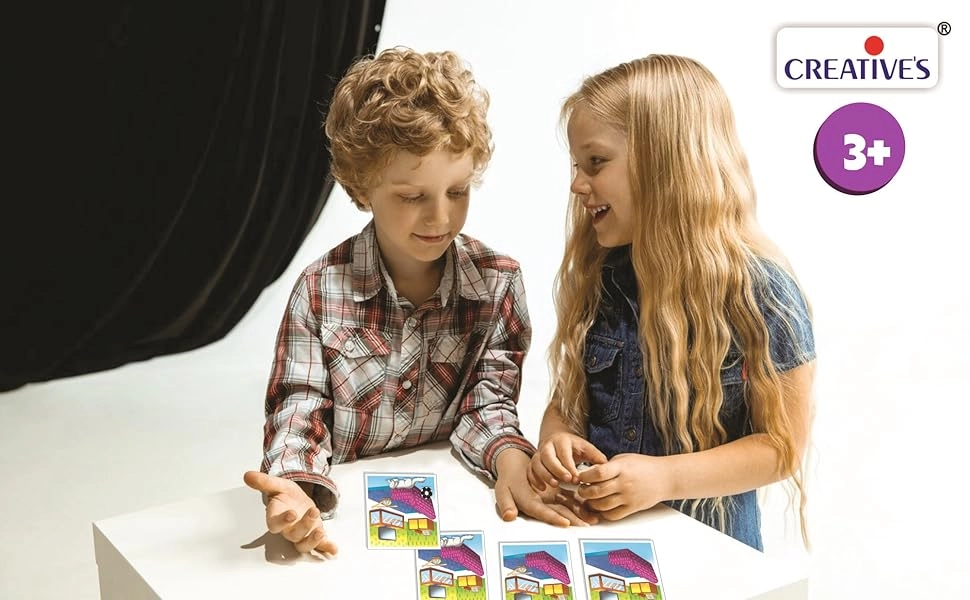
A child lays the four cards out, describes each scene, and tracks the new
addition as it appears in each picture. The process of describing what is
in each card and explaining what changed builds vocabulary, sentence
construction, and logical sequencing in a single activity.
Cards are numbered on the back for self-checking, so children can verify
their own sequences.

Parents value this game because the sequential mechanic is genuinely
different from other picture card games and holds children’s attention
in a new way. Teachers choose it because language development, logical
thinking, and spatial perception are all built into one compact card activity.

HOW CHILDREN LEARN

  • A child lays out a set of four cards and spots that the first shows a
    dog in its kennel, the second adds a bone, the third adds a frisbee,
    the fourth adds a football — tracking that progression builds
    sequential reasoning.
  • Describing each card before moving to the next — “this one has the
    dog and the bone” — builds vocabulary, sentence construction, and
    the habit of looking carefully before speaking.
  • Noticing what is new in each picture rather than what has been removed
    is a distinct cognitive challenge: children must hold the previous card
    in mind and compare it forward, not backward.
  • The self-checking numbers on the back of each card let children verify
    their own sequences independently, building confidence and self-correction
    habits without needing adult input.
  • Observing spatial relationships — where the new element appears within
    the scene — lays early groundwork for the spatial reasoning and
    positional language used in maths and science.

SKILLS DEVELOPED

  • Observation & Concentration
  • Logical Thinking & Sequencing
  • Language Development & Vocabulary
  • Development of Perception
  • Spatial Awareness
  • Cognitive Development
  • Visual Discrimination

WHO IS IT FOR

  • Children aged 3 to 7 who are ready to track sequential changes
    in pictures and describe what they notice in their own words.
  • Parents looking for a screen-free card game that is genuinely
    different from standard puzzles and holds a young child’s
    attention through a novel visual challenge.
  • Early years and nursery teachers who need a language and
    sequencing activity that works for individual or small-group sessions.
  • Homeschooling parents covering language development, logical
    sequencing, and early spatial reasoning through structured card play.
  • Speech and language support educators who use picture description
    and sequencing tasks in structured play and therapy-friendly
    learning settings.
  • Gift-givers looking for an age 3+ educational card game that builds
    three distinct skills — language, logic, and perception in one compact set.

PRODUCT FEATURES TABLE

Age Group: 3 Years and Up

Players: 1 or more (individual, paired, or group)

Play Type: Sequential Picture Observation & Language Card Activity

Educational Category: Logical Thinking | Language Development
| Perception | Observation | Sequencing

Game Mechanic: One new element added per card within each set
of 4 children identify the addition and sequence correctly

Contents: 12 sets of 4 picture cards (48 cards total) + self-checking
numbers on reverse

Difficulty: Cards numbered by level of difficulty; difficulty
increases across sets

Reference Number: 0627

Made In: India

Safety Certifications: CE | ISO 9001:2000 Certified
Company | Not suitable for children under 3 years (small parts)

Series: Early Memory Games

Brand: Creative’s (Creative Educational Aids Pvt. Ltd.)

Weight0.682 kg
Dimensions23.5 × 27.5 × 5 cm
  • Play, Learn & Grow
  • Super-Fast Delivery
  • Skill Based Educational Toys
  • Premium Quality

Description

Creative’s What’s the Difference? is a sequential picture card game from
the Early Memory Games series with a mechanic that sets it apart from
standard spot-the-difference games. Across 12 sets of four illustrated
cards, one new element is added from picture to picture. Children aged
3 and up must identify what has been added at each step and arrange the
cards in the correct order.

A child lays the four cards out, describes each scene, and tracks the new
addition as it appears in each picture. The process of describing what is
in each card and explaining what changed builds vocabulary, sentence
construction, and logical sequencing in a single activity.
Cards are numbered on the back for self-checking, so children can verify
their own sequences.

Parents value this game because the sequential mechanic is genuinely
different from other picture card games and holds children’s attention
in a new way. Teachers choose it because language development, logical
thinking, and spatial perception are all built into one compact card activity.

HOW CHILDREN LEARN

  • A child lays out a set of four cards and spots that the first shows a
    dog in its kennel, the second adds a bone, the third adds a frisbee,
    the fourth adds a football — tracking that progression builds
    sequential reasoning.
  • Describing each card before moving to the next — “this one has the
    dog and the bone” — builds vocabulary, sentence construction, and
    the habit of looking carefully before speaking.
  • Noticing what is new in each picture rather than what has been removed
    is a distinct cognitive challenge: children must hold the previous card
    in mind and compare it forward, not backward.
  • The self-checking numbers on the back of each card let children verify
    their own sequences independently, building confidence and self-correction
    habits without needing adult input.
  • Observing spatial relationships — where the new element appears within
    the scene — lays early groundwork for the spatial reasoning and
    positional language used in maths and science.

SKILLS DEVELOPED

  • Observation & Concentration
  • Logical Thinking & Sequencing
  • Language Development & Vocabulary
  • Development of Perception
  • Spatial Awareness
  • Cognitive Development
  • Visual Discrimination

WHO IS IT FOR

  • Children aged 3 to 7 who are ready to track sequential changes
    in pictures and describe what they notice in their own words.
  • Parents looking for a screen-free card game that is genuinely
    different from standard puzzles and holds a young child’s
    attention through a novel visual challenge.
  • Early years and nursery teachers who need a language and
    sequencing activity that works for individual or small-group sessions.
  • Homeschooling parents covering language development, logical
    sequencing, and early spatial reasoning through structured card play.
  • Speech and language support educators who use picture description
    and sequencing tasks in structured play and therapy-friendly
    learning settings.
  • Gift-givers looking for an age 3+ educational card game that builds
    three distinct skills — language, logic, and perception in one compact set.

PRODUCT FEATURES TABLE

Age Group: 3 Years and Up

Players: 1 or more (individual, paired, or group)

Play Type: Sequential Picture Observation & Language Card Activity

Educational Category: Logical Thinking | Language Development
| Perception | Observation | Sequencing

Game Mechanic: One new element added per card within each set
of 4 children identify the addition and sequence correctly

Contents: 12 sets of 4 picture cards (48 cards total) + self-checking
numbers on reverse

Difficulty: Cards numbered by level of difficulty; difficulty
increases across sets

Reference Number: 0627

Made In: India

Safety Certifications: CE | ISO 9001:2000 Certified
Company | Not suitable for children under 3 years (small parts)

Series: Early Memory Games

Brand: Creative’s (Creative Educational Aids Pvt. Ltd.)

Additional information

Weight0.682 kg
Dimensions23.5 × 27.5 × 5 cm

Skill Development

Problem-Solving Skills

Hand Eye Coordination

Concentration

Age Group

Add a review
Creative’s What’s the Difference? Sequential Picture Game Ages 3+ Creative’s What’s the Difference? Sequential Picture Game Ages 3+
Rating*
0/5
* Rating is required
Your review
* Review is required
Name
* Name is required
Add photos or video to your review
4.0
Based on 1 review
5 star
0%
4 star
100
100%
3 star
0%
2 star
0%
1 star
0%
1-1 of 1 review
  1. SJ
    Quality & Learning Together

    Good educational toy for young kids. Excellent for classroom-style learning at home; very practical. Clear visuals and good quality—my child understood it quickly.