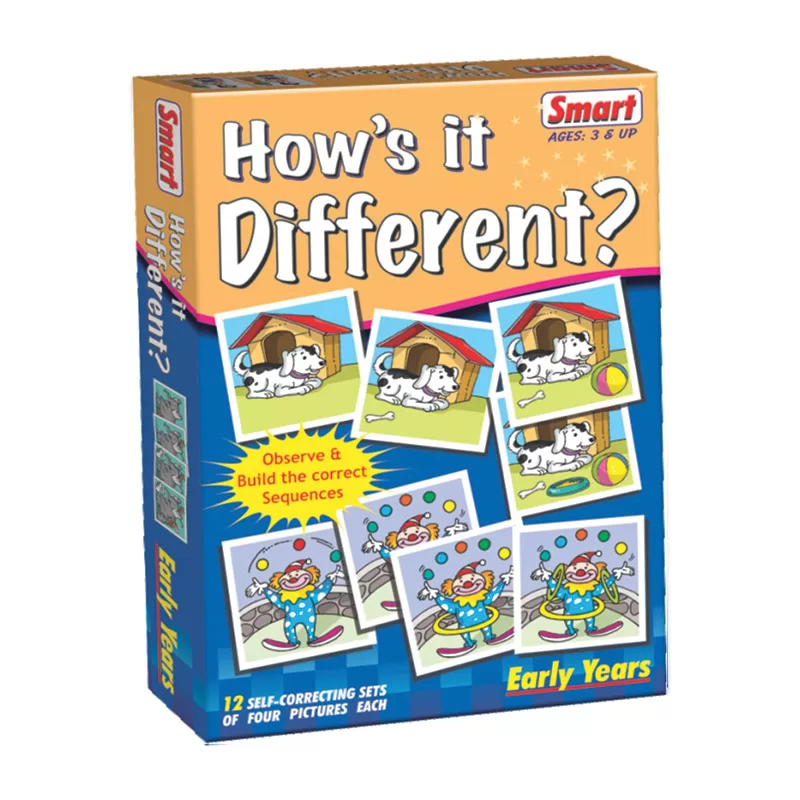
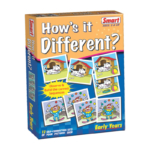
Smart How’s it Different? gives children aged 3 & up 12 self-correcting sets of four pictures to study carefully, spot the progressive changes and arrange in the correct sequence. Builds sharp visual discrimination, keen observation and sequential thinking through hands-on picture play.
About This Product
VISUAL DIFFERENCE SEQUENCING ACTIVITY 12 self-correcting sets of 4 pictures each children spot progressive changes and arrange cards in the correct sequence.
OBSERVE & BUILD SEQUENCES MECHANIC Each set shows the same scene with subtle differences across 4 pictures children study carefully and order by change.
SCREEN-FREE VISUAL DISCRIMINATION PLAY Hands-on card observation and ordering sharpens attention to detail and visual thinking without screens.
HOME, CLASSROOM & THERAPY USE Supports structured observation and visual reasoning across home, school and therapy-friendly environments.
QUALITY, SAFETY & TRUST Smart products are proudly made in India, conforming to BIS Safety Standards (IS 9873 – Part 1) and EN71 Part 1, 2 & 3 with European Toy Safety Standards trusted by parents and educators since 1987.
Smart How's it Different? is a set of 12 self-correcting four-picture card
sequences for children aged 3 and up. Each set shows the same scene
across four cards — but something changes progressively from picture
to picture. Children study all four cards, identify the differences and
arrange them in the correct sequence. Sets include a dog and kennel
with objects appearing one by one, a clown juggling with progressively
more props, cats in different positions, and more.
Unlike simple matching or story sequencing, this activity requires
children to hold all four images in mind simultaneously and reason
about what is changing — building working memory, visual discrimination
and systematic observation. The self-correcting format confirms every
correct sequence without adult input, building independent confidence.
Parents and teachers choose this set because the visual reasoning it
builds is directly transferable to science observation, reading comprehension
and mathematical pattern recognition. Often used in structured play
and therapy-friendly learning settings, it is open-ended, discussion-rich
and genuinely challenging from age 3.
HOW CHILDREN LEARN
A child picks up 4 dog-and-kennel cards and studies each
one carefully noticing that objects appear progressively:
first a bone, then a ball, then a frisbee then places them in
the order the scene is building.
The self-correcting format confirms every correct sequence children
learn to trust their own observation and adjust without adult input
when something doesn't fit.
Describing what is different between each card aloud 'this one has
a ball but no frisbee' builds precise descriptive language and the
habit of noticing detail before acting.
Working across 12 varied sets dogs, clowns, cats and more trains
children to look systematically at a whole picture before spotting
the specific change, a skill central to early reading and scientific
observation.
The progressive-difference format is more demanding than simple
matching children must hold all four cards in mind simultaneously,
building working memory and sustained concentration.
SKILLS DEVELOPED
Visual Discrimination
Keen Observation
Sequential Thinking
Concentration & Working Memory
Logical Thinking
Descriptive Language
Attention to Detail
WHO IS IT FOR
Parents building sharp observation and visual thinking with
children aged 3 to 7 at home.
Preschool and kindergarten teachers running visual discrimination
and sequencing activities.
Occupational therapists using visual attention and detail-noticing
tasks in structured sessions.
Speech and language therapists using picture-based description
tasks to build descriptive and observational language.
Homeschooling families looking for a self-directed, screen-free
visual reasoning activity from age 3.
Learning centres stocking hands-on visual discrimination
resources for early years observation groups.
PRODUCT FEATURES
Age Group: 3 Years & Up Players: 1 or more (individual or group play) Play Type: Four-Picture Self-Correcting Visual Sequencing Activity Educational Category: Visual Discrimination • Observation
• Sequential Thinking Contents: 12 Self-Correcting Sets of Four Pictures Each (48 cards total) Card Format: 4 Pictures per Set Showing the Same Scene
with Progressive Differences Safety Certifications: BIS IS 9873 (Part 1)
• EN71 Part 1, 2 & 3 • CE Marked
Smart How’s it Different? is a set of 12 self-correcting four-picture card
sequences for children aged 3 and up. Each set shows the same scene
across four cards — but something changes progressively from picture
to picture. Children study all four cards, identify the differences and
arrange them in the correct sequence. Sets include a dog and kennel
with objects appearing one by one, a clown juggling with progressively
more props, cats in different positions, and more.
Unlike simple matching or story sequencing, this activity requires
children to hold all four images in mind simultaneously and reason
about what is changing — building working memory, visual discrimination
and systematic observation. The self-correcting format confirms every
correct sequence without adult input, building independent confidence.
Parents and teachers choose this set because the visual reasoning it
builds is directly transferable to science observation, reading comprehension
and mathematical pattern recognition. Often used in structured play
and therapy-friendly learning settings, it is open-ended, discussion-rich
and genuinely challenging from age 3.
HOW CHILDREN LEARN
A child picks up 4 dog-and-kennel cards and studies each
one carefully noticing that objects appear progressively:
first a bone, then a ball, then a frisbee then places them in
the order the scene is building.
The self-correcting format confirms every correct sequence children
learn to trust their own observation and adjust without adult input
when something doesn’t fit.
Describing what is different between each card aloud ‘this one has
a ball but no frisbee’ builds precise descriptive language and the
habit of noticing detail before acting.
Working across 12 varied sets dogs, clowns, cats and more trains
children to look systematically at a whole picture before spotting
the specific change, a skill central to early reading and scientific
observation.
The progressive-difference format is more demanding than simple
matching children must hold all four cards in mind simultaneously,
building working memory and sustained concentration.
SKILLS DEVELOPED
Visual Discrimination
Keen Observation
Sequential Thinking
Concentration & Working Memory
Logical Thinking
Descriptive Language
Attention to Detail
WHO IS IT FOR
Parents building sharp observation and visual thinking with
children aged 3 to 7 at home.
Preschool and kindergarten teachers running visual discrimination
and sequencing activities.
Occupational therapists using visual attention and detail-noticing
tasks in structured sessions.
Speech and language therapists using picture-based description
tasks to build descriptive and observational language.
Homeschooling families looking for a self-directed, screen-free
visual reasoning activity from age 3.
Learning centres stocking hands-on visual discrimination
resources for early years observation groups.
PRODUCT FEATURES
Age Group: 3 Years & Up Players: 1 or more (individual or group play) Play Type: Four-Picture Self-Correcting Visual Sequencing Activity Educational Category: Visual Discrimination • Observation
• Sequential Thinking Contents: 12 Self-Correcting Sets of Four Pictures Each (48 cards total) Card Format: 4 Pictures per Set Showing the Same Scene
with Progressive Differences Safety Certifications: BIS IS 9873 (Part 1)
• EN71 Part 1, 2 & 3 • CE Marked
Good educational toy for young kids. Clear visuals and good quality—my child understood it quickly. Simple concept, strong learning impact—works well for preschoolers.






Good educational toy for young kids. Clear visuals and good quality—my child understood it quickly. Simple concept, strong learning impact—works well for preschoolers.