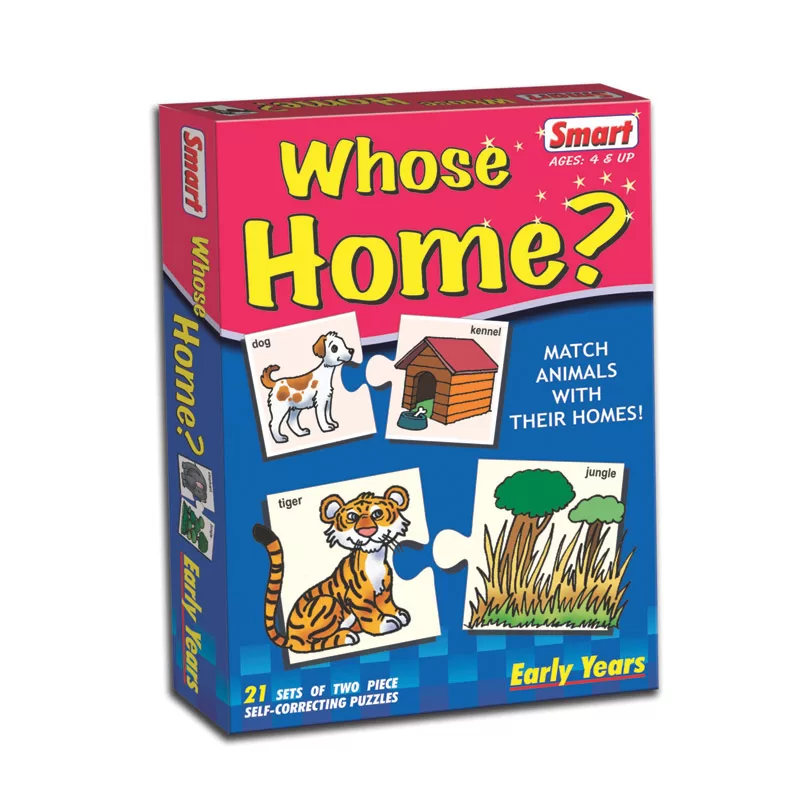
Smart Whose Home? gives children aged 4 and up 21 self-correcting two-piece puzzles – each matching an animal to its named home or habitat. Dog connects to kennel, tiger connects to jungle. Self-correcting puzzle shapes mean only the right animal-home pair physically fits, building habitat vocabulary, observation skills, and nature awareness independently.
About This Product
ANIMAL HABITAT MATCHING PUZZLE 21 SELF-CORRECTING PAIRS – 21 two-piece puzzles matching animals to their named homes – dog/kennel, tiger/jungle and 19 more animal-habitat pairs for ages 4 and up.
SELF-CORRECTING PUZZLE SHAPES INDEPENDENT PLAY – Each puzzle pair has a unique interlocking shape – only the correct animal-home match physically fits together, so children verify answers without adult help.
ANIMAL HOMES VOCABULARY NATURE & SCIENCE AWARENESS – Every piece is labelled with the animal name and home name – children learn that a dog lives in a kennel and a tiger lives in a jungle through hands-on matching.
SCREEN-FREE HABITAT MATCHING ACTIVITY HOME & CLASSROOM – Builds observation, vocabulary, logical thinking, and nature awareness; suits independent home play, nursery activity stations, and early science sessions.
QUALITY, SAFETY & TRUST – Smart Early Years products are proudly made in India, conforming to CE Mark safety standards – trusted by parents and educators as part of the Early Years Series.
Smart Whose Home? teaches children aged 4 and up where 21 different
animals live - through self-correcting puzzle pairs that only fit when
the match is correct. Each of the 21 sets connects an animal piece to
its named home or habitat: dog to kennel, tiger to jungle, and more.
Both pieces are labelled, so children read the home name as they
make each match, building habitat vocabulary naturally through
activity rather than instruction.
The self-correcting puzzle design makes independent play possible
from age 4: if a child tries the wrong home for an animal, the puzzle
shapes won't interlock. They try again until the correct pair clicks.
No adult needs to confirm the answer. The activity builds not just
knowledge of animal homes but the logical thinking habit of working
from evidence to a conclusion rather than guessing.
Parents and teachers choose Whose Home? because animal habitat
knowledge is a genuine early science curriculum topic, and the
self-correcting format makes it accessible and independent from
age 4. It is often used in structured play and therapy-friendly learning
settings for vocabulary, observation, and logical thinking development.
It pairs naturally with Whose Baby? as a companion set for children
who have already worked through the baby animal matching activity.
How Children Learn
A child picks up the tiger piece and must think: where does a tiger live?
They try the jungle piece - it clicks into place.
This is knowledge-based matching, not just visual pattern recognition,
meaning children must draw on what they know about animals
to succeed.
The self-correcting mechanism provides immediate feedback
without adult involvement: if a child tries to match a dog to the
wrong home, the puzzle pieces won't fit.
They try again - learning through trial and consequence rather
than being told the answer.
Reading the label on each home piece - kennel, jungle, and more
introduces habitat vocabulary that connects directly to early
geography and science topics. Children who know a tiger lives
in a jungle carry that knowledge into classroom discussions
about wild and domestic animals.
Sorting the 42 pieces before matching - separating animals
from homes - builds classification thinking: these are the animals,
these are the places. This category-sorting step adds a second
cognitive layer to the same 21-pair set.
Pairing Whose Home? with Whose Baby? (the companion set
for ages 3+) lets children work across two animal knowledge
frameworks with the same self-correcting puzzle format - extending
learning time and reinforcing curiosity about animals.
Skills Developed
Animal Habitat & Nature Awareness
Vocabulary Building
Logical Thinking & Reasoning
Observation & Concentration
Cognitive Development
Classification & Sorting
Early Science & Geography Concepts
Who Is It For
Children aged 4 and above who are curious about animals and
ready to learn where different animals live.
Parents looking for a self-directed puzzle activity that builds
nature and science vocabulary without adult supervision.
Nursery and reception teachers covering animals and habitats
in early science or geography sessions.
Parents who already own Whose Baby? and want the companion
animal-homes set for the same child at age 4.
Speech and language practitioners working on habitat vocabulary,
category naming, and logical reasoning with young learners.
Gift-buyers looking for a nature-themed vocabulary puzzle
gift for a child aged 4 to 7.
PRODUCT FEATURES
Age Group: 4 Years & Above Number of Players: 1 or more Play Type: Self-Correcting Matching Puzzle
• Animal Habitat Vocabulary Activity Educational Category: Animal Habitats • Nature & Science
• Vocabulary • Logical Thinking Contents: 21 Sets of Two-Piece Self-Correcting Puzzles (42 pieces total) Animal–Home Pairs Confirmed: Dog/Kennel • Tiger/Jungle Self-Correcting Feature: Each puzzle pair has a unique interlocking
shape only the correct animal–home match physically fits Companion Set: Pairs with Whose Baby? (Ref 01006, ages 3+)
same format, different knowledge content Brand: Smart — Early Years Series Safety Certifications: CE Mark Reference Number: 01007
Smart Whose Home? teaches children aged 4 and up where 21 different
animals live – through self-correcting puzzle pairs that only fit when
the match is correct. Each of the 21 sets connects an animal piece to
its named home or habitat: dog to kennel, tiger to jungle, and more.
Both pieces are labelled, so children read the home name as they
make each match, building habitat vocabulary naturally through
activity rather than instruction.
The self-correcting puzzle design makes independent play possible
from age 4: if a child tries the wrong home for an animal, the puzzle
shapes won’t interlock. They try again until the correct pair clicks.
No adult needs to confirm the answer. The activity builds not just
knowledge of animal homes but the logical thinking habit of working
from evidence to a conclusion rather than guessing.
Parents and teachers choose Whose Home? because animal habitat
knowledge is a genuine early science curriculum topic, and the
self-correcting format makes it accessible and independent from
age 4. It is often used in structured play and therapy-friendly learning
settings for vocabulary, observation, and logical thinking development.
It pairs naturally with Whose Baby? as a companion set for children
who have already worked through the baby animal matching activity.
How Children Learn
A child picks up the tiger piece and must think: where does a tiger live?
They try the jungle piece – it clicks into place.
This is knowledge-based matching, not just visual pattern recognition,
meaning children must draw on what they know about animals
to succeed.
The self-correcting mechanism provides immediate feedback
without adult involvement: if a child tries to match a dog to the
wrong home, the puzzle pieces won’t fit.
They try again – learning through trial and consequence rather
than being told the answer.
Reading the label on each home piece – kennel, jungle, and more
introduces habitat vocabulary that connects directly to early
geography and science topics. Children who know a tiger lives
in a jungle carry that knowledge into classroom discussions
about wild and domestic animals.
Sorting the 42 pieces before matching – separating animals
from homes – builds classification thinking: these are the animals,
these are the places. This category-sorting step adds a second
cognitive layer to the same 21-pair set.
Pairing Whose Home? with Whose Baby? (the companion set
for ages 3+) lets children work across two animal knowledge
frameworks with the same self-correcting puzzle format – extending
learning time and reinforcing curiosity about animals.
Skills Developed
Animal Habitat & Nature Awareness
Vocabulary Building
Logical Thinking & Reasoning
Observation & Concentration
Cognitive Development
Classification & Sorting
Early Science & Geography Concepts
Who Is It For
Children aged 4 and above who are curious about animals and
ready to learn where different animals live.
Parents looking for a self-directed puzzle activity that builds
nature and science vocabulary without adult supervision.
Nursery and reception teachers covering animals and habitats
in early science or geography sessions.
Parents who already own Whose Baby? and want the companion
animal-homes set for the same child at age 4.
Speech and language practitioners working on habitat vocabulary,
category naming, and logical reasoning with young learners.
Gift-buyers looking for a nature-themed vocabulary puzzle
gift for a child aged 4 to 7.
PRODUCT FEATURES
Age Group: 4 Years & Above Number of Players: 1 or more Play Type: Self-Correcting Matching Puzzle
• Animal Habitat Vocabulary Activity Educational Category: Animal Habitats • Nature & Science
• Vocabulary • Logical Thinking Contents: 21 Sets of Two-Piece Self-Correcting Puzzles (42 pieces total) Animal–Home Pairs Confirmed: Dog/Kennel • Tiger/Jungle Self-Correcting Feature: Each puzzle pair has a unique interlocking
shape only the correct animal–home match physically fits Companion Set: Pairs with Whose Baby? (Ref 01006, ages 3+)
same format, different knowledge content Brand: Smart — Early Years Series Safety Certifications: CE Mark Reference Number: 01007
Works perfectly for our daily play time. Keeps hands busy and supports coordination and early problem-solving. Excellent for classroom-style learning at home; very practical.







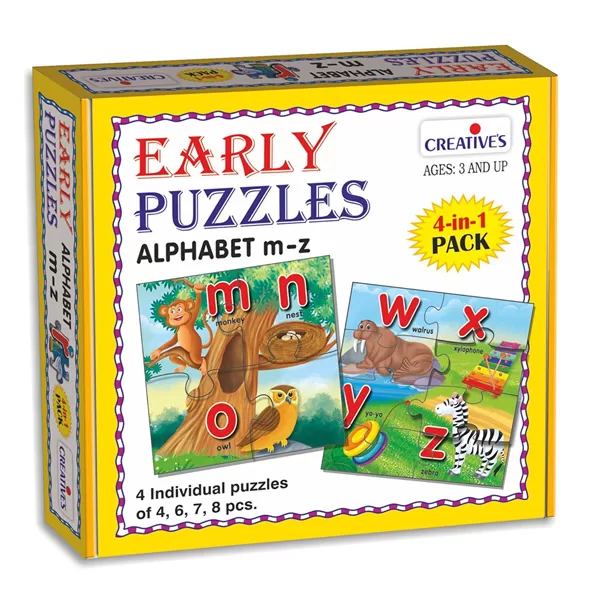

Works perfectly for our daily play time. Keeps hands busy and supports coordination and early problem-solving. Excellent for classroom-style learning at home; very practical.